Phishing Simulations in 2026: Open-Source Tools vs Paid Platforms

Phishing attacks continue to evolve, and even with strong technical controls in place, a well-crafted phishing message can still bypass defences by exploiting human behavior.
In 2026, phishing is no longer limited to email. Attackers routinely combine email, SMS, QR codes, and voice calls often using AI-generated content to increase credibility and urgency.
To reduce this risk, organizations use phishing simulations to train employees and measure how people respond to real-world social engineering techniques.
When implementing phishing simulations, you face a key decision: do you use an open-source phishing simulation tool that offers flexibility but requires hands-on management, or invest in a paid phishing simulation platform that is ready to deploy and operate at scale.
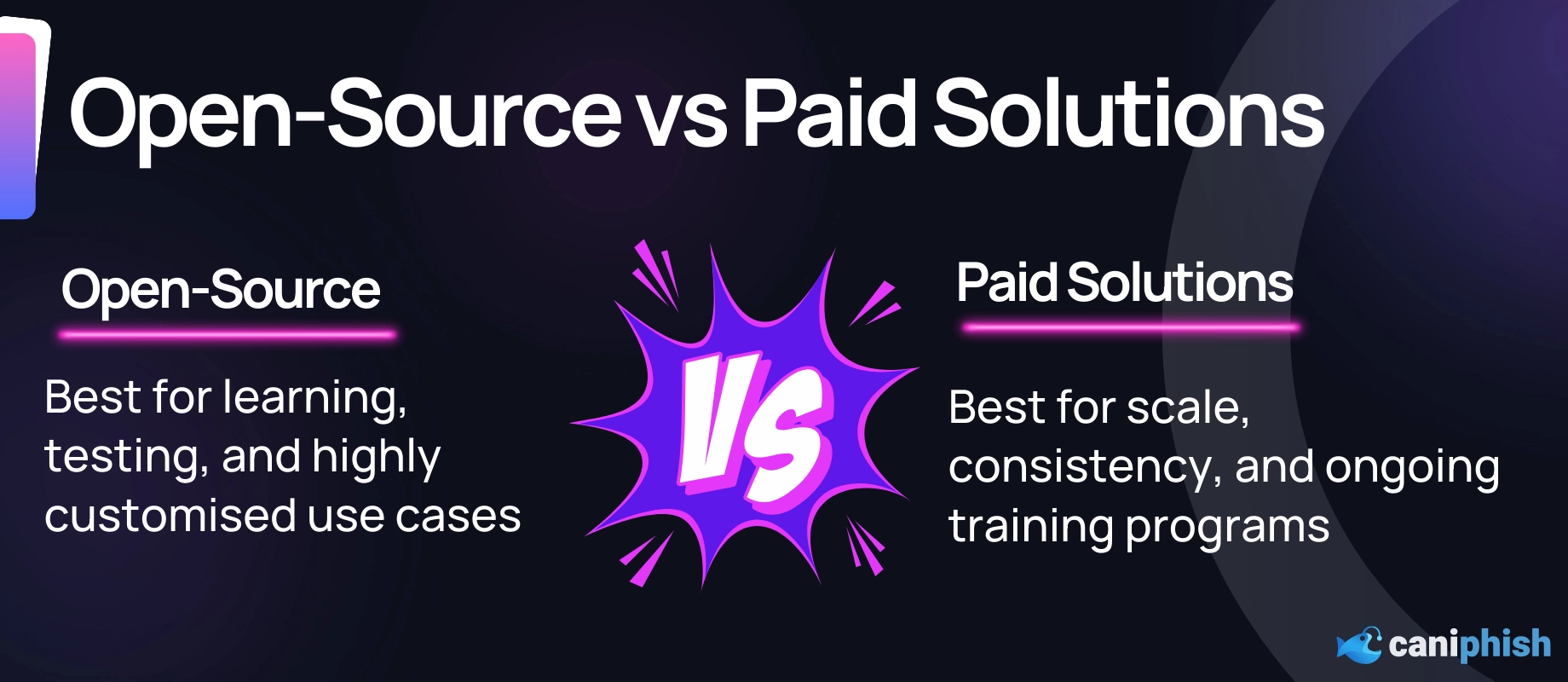
This article explores both options, highlighting where open-source phishing tools work well, where they fall short, and when a paid platform is the right fit based on your resources, goals, and internal capability.
What Is an Open-Source Phishing Simulation Tool?
An open-source phishing simulation tool is a self-hosted platform used to simulate phishing attacks for training and testing purposes. Tools such as Gophish are developed and maintained by a community and made publicly available under open-source licenses.
These tools give organizations full control over their phishing simulations, including infrastructure, configuration, and data storage. As a result, they are commonly used by security teams, penetration testers, and red teamers who want flexibility and transparency.
Benefits of Open-Source Phishing Simulation Tools
- No upfront cost. Open-source phishing tools are free to use. If you’re working with a tight/no budget, it’s an attractive option.
- Transparency and visibility. Because the source code is publicly available, you can inspect how the tool works and understand exactly how data is handled.
- Full control over infrastructure. You decide where the platform is hosted, how emails are sent, and how campaigns are configured. This level of control is useful for custom testing scenarios.
- Strong learning value. Running an open-source phishing simulation tool provides hands-on experience. For penetration testers and red teamers, this can deepen understanding of phishing techniques and delivery mechanics.
- You're not locked in. There are no subscriptions, licensing terms, or commercial dependencies. You can come and go at any time.
Limitations of Open-Source Phishing Simulation Tools
- Time and expertise required. While open-source phishing tools are free, they are not plug-and-play. Setup, configuration, and ongoing maintenance require technical skill and time.
- Content creation and maintenance. Most open-source phishing simulation tools do not include ready-made phishing templates. You are responsible for creating, testing, and continually updating content. In 2026, phishing themes change quickly, and outdated simulations lose training value.
- Limited support. Bug fixes, feature updates, and long-term maintenance are not guaranteed as open-source tools rely on community contributions.
- Missing enterprise functionality. Compared to paid platforms, open-source tools often lack features such as automated reporting, phishing websites, single sign-on (SSO), multi-language support, voice phishing, phish reporting, AI-powered tooling and native integrations with Entra ID or Google Workspace.
- Integration overhead. Connecting an open-source phishing framework to identity providers, reporting workflows, dashboards, or HR systems typically requires custom development and ongoing upkeep.
When Paid Phishing Simulation Platforms Make Sense
Choosing between open-source and paid phishing tools is similar to choosing between building your own system and operating a managed service.
Open-source tools give you flexibility and control, but they also introduce operational overhead. Paid phishing simulation platforms are designed to be easy-to-use and remove that burden, allowing teams to focus on training outcomes rather than infrastructure and maintenance.
Operational Benefits of Paid Phishing Simulation Platforms
- Professional support. Paid platforms provide structured support through tickets, chat, email, phone and video conference. You get quick help whenever you need it.
- Managed infrastructure. Email delivery, phishing websites, and hosting are managed by the vendor, reducing risk and operational effort.
- Ready-to-use content. Paid tools include curated phishing email templates, landing pages, and training modules that are regularly updated to reflect current attack trends.
- Broader functionality out of the box Features such as detailed reporting, executive dashboards, SSO, multi-language support, domain scanning, and identity integrations are included rather than custom-built.
- Fast deployment. Most paid platforms can be configured and launched quickly, allowing teams to run campaigns without lengthy setup.
- Designed for scale. Paid phishing platforms are built to support growing organizations, larger user bases, and continuous training programs.
- Ongoing improvements. New features, attack techniques, and platform updates are delivered as part of the service.
Open-Source vs Paid Phishing Simulation Tools: Feature Comparison
In this section, we compare CanIPhish, a fully managed phishing simulation and security awareness platform, with Gophish, the most widely used open-source phishing simulation tool.
This comparison highlights which capabilities must be built and maintained internally when using an open-source tool, versus what is included by default in a paid platform.
| Phishing Simulation Tools | CanIPhish Proprietary | Gophish Open-Source | |
|---|---|---|---|
| Platform & Deployment | |||
| Perpetual Free Tier | |||
| SaaS Deployment | |||
| On-Premise Deployment | |||
| Open-Source Codebase | Limited | ||
| Managed Mail Servers | |||
| Managed Phishing Websites | |||
| Configurable Infrastructure | |||
| Core Phishing Simulation Features | |||
| Training Modules | |||
| Email Template Editor | |||
| Phishing Email Library | |||
| Phishing Website Library | |||
| Campaign Scheduling | Limited | ||
| Sender Domain Spoofing | |||
| Executive Reporting | Limited | ||
| Gamification | |||
| Multi-Language Functionality | |||
| Attack Channels | |||
| Email Phishing | |||
| Voice Phishing (Vishing) | |||
| QR Code Phishing (Quishing) | |||
| Conversational Phishing | |||
| Advanced Simulation Capabilities | |||
| Generative AI Integrations | |||
| Email Cloning | |||
| AI-Powered Email Analysis | |||
| OSINT-Powered Phishing | |||
| Interactive Email Sandboxing | |||
| Integrations & Automation | |||
| Domain Scanning Tools | |||
| Webhook Support | |||
| Multi Tenant Capabilities | |||
| Azure AD & Google Workspace Integration | |||
| Office 365 & Google Workspace Report Phish Add-ons | |||
| Support, Security & Governance | |||
| Dark Web Monitoring | |||
| Long-term Platform Support | Limited | ||
| Ticket, Chat, Email and Phone Support | |||
| Comprehensive Knowledge Base | Limited | ||
| Configurable Cloud Data Storage | |||
| Single Sign-On (SAML) | |||
| Configurable Multi-Factor Authentication | |||
| SOC 2 Compliant Phishing Simulations | |||
| *Comparison based on publicly accessible data. | Sign-up Free | ||
Which Phishing Simulation Tool Is Right for Your Organization?
Both options have clear strengths and trade-offs. The right choice depends on whether you are optimizing for flexibility and learning, or for consistency, scale, and operational efficiency.

Who Should Use a Paid Phishing Simulation Platform
Paid phishing simulation platforms are a strong fit when you need outcomes without operational overhead.
Ideal for organizations that want:
- Reliable delivery at scale
- Up to date content and training modules
- Clear reporting for leadership and compliance
With managed infrastructure and regular updates, your team can focus on improving security behavior rather than maintaining tooling.

Who Should Use an Open-Source Phishing Simulation Tool
Open source phishing simulation tools are a strong fit when you want flexibility and can manage the platform internally.
Ideal for teams that have:
- Strong technical capability to deploy and maintain infrastructure
- Time to build and refresh phishing content regularly
- A need for highly customized testing scenarios
With the right effort, tools like Gophish give you control without licensing costs.
Frequently Asked Questions
What's the difference between phishing tools and anti-phishing tools?
Phishing tools simulate attacks for training and testing purposes, helping organizations improve their security posture by finding weaknesses, that can be addressed, in their human defense. These tools usually include training capabilities baked into them. Anti-phishing tools are used to detect and block real phishing attempts, providing protection by flagging suspicious content and preventing malicious activity.
What operating system do phishing simulation tools run on?
Most phishing simulation tools operate on a SaaS (Software as a Service) model, meaning you can access them directly through a web browser. Open-source platforms like Gophish, are downloaded and support multiple operating systems, including Windows, macOS, and Linux.
Can red teamers (pen testers) use paid phishing tools?
Yes, but it depends on the platform and what features you need. Some paid tools prioritize ease of use, simplifying onboarding but offering less flexibility in terms of customization and sending infrastructure. On the other hand, platforms like CanIPhish offer more control, including the option to BYO (Bring Your Own) Infrastructure, allowing red teamers to fully customize how phishing simulations are sent.
Is Gophish still a good open-source phishing simulation tool in 2026?
Gophish remains a solid option for learning, testing, and small-scale phishing simulations. However, organizations running ongoing training programs or operating at scale often outgrow it due to content maintenance, reporting, and integration requirements.
Learn the 14 steps to become an expert ethical hacker!
Read the blog