What Is An AI Security Coach?

An AI cybersecurity coach is a real-time cybersecurity assistant embedded in the tools you use day-to-day, most commonly within email. It monitors behaviors and delivers immediate, contextual guidance when someone's at risk of falling victim to a cybersecurity threat.
How AI Security Coaches Improve Security Culture
AI cybersecurity coaches are built to improve real-world behavior. Rather than relying on training and annual refreshers that can cause anxiety, these tools step in at key decision points to reinforce caution, build confidence, and improve day-to-day cybersecurity hygiene.
It makes cybersecurity learning feel collaborative rather than punitive. When a user gets a helpful prompt, it creates a feedback loop in learning. Over time, employees become more naturally aware of red flags, they pause before clicking questionable links, and scrutinize requests that seem slightly off. Small, consistent nudges that shape long-term behavior.
Think of it like learning to cross the street. At first, parents need to remind their kids to look both ways. Over time, it becomes muscle memory and reminders are no longer necessary.
That's what AI cybersecurity coaches are aiming for. To turn cautious behavior into instinct. One timely nudge at a time.
Examples of an AI Security Coach in Action
These systems are designed to be unobtrusive. The AI cybersecurity coach only steps in when suspicious activity has been observed.
Here's a couple of examples of what it looks like in everyday work.
1) Suspicious Link In An Email
A staff member receives an urgent request which appears to be from a vendor asking them to confirm an invoice. The message includes a link to “review” the invoice, and the tone pushes for an urgent response.
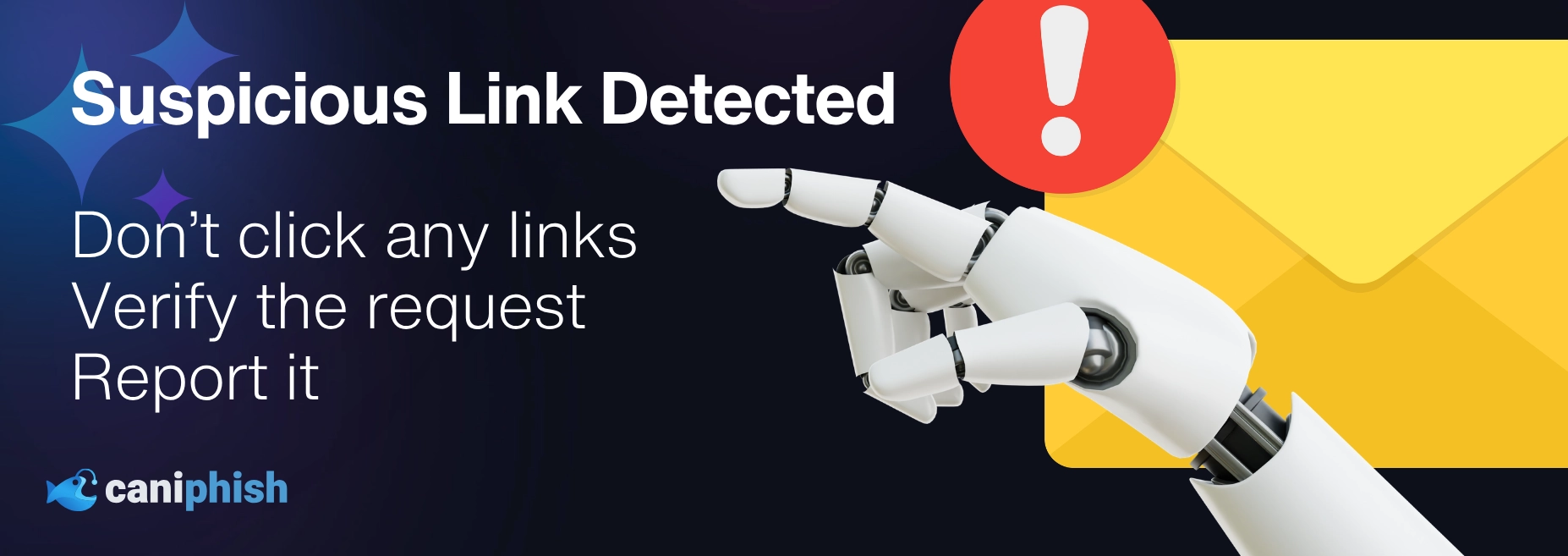
As soon as the email is opened, the AI cybersecurity coach begins analyzing it in the background within the email client. Within a few seconds, a result surfaces that says the email is a phish, and it explains why in simple terms.
The security coach looks for contextual information about the senders relationship with the staff member, if there are any indicators of impersonation, email address spoofing, malicious attachments, malicious links and much more.
The coach then gives clear next steps, which in this scenario would typically include:
- Don’t click or open the attachment
- Verify the request using a trusted channel
- Use the built in report option to send the email to security
The key is that the user gets guidance the moment they are about to act.
2) Executive Impersonation Attempt
An employee receives what appears to be a routine request from a senior executive, asking for financial details with the words “must happen today.” The request sounds plausible, and the sender's name looks legit at first glance.
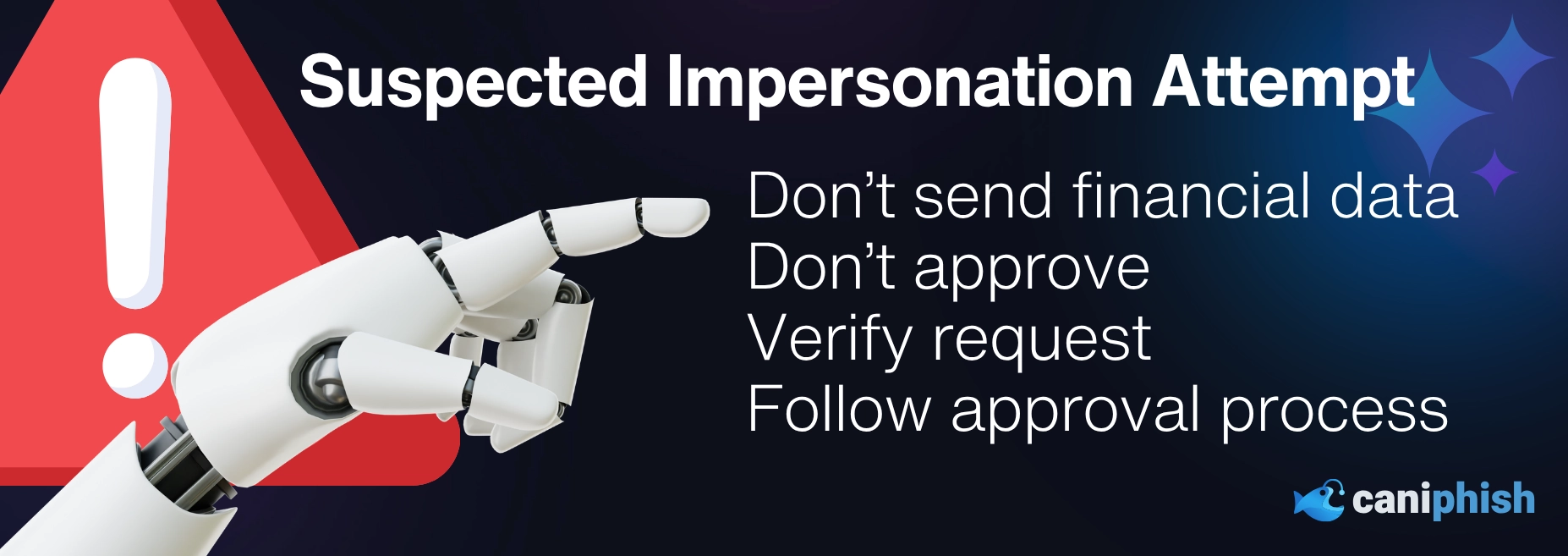
The AI cybersecurity coach starts evaluating the message. Within seconds, it flags the email as a phish and explains in layman terms why. In the case of an executive impersonation attempt it identifies discrepances between the internal organizational registry and the email address of the sender. This is all that’s needed to give the AI security coach enough context to understand that the request is malicious, and surface this directly to the user.
The coach then recommends specific actions to take that reduce risk without slowing work unnecessarily:
- Don’t send financial data
- Don’t approve any changes based on this email
- Verify using a secondary channel, like phone or face-to-face confirmation if possible
- Even though it’s urgent, follow the organization’s payment and approval process
This is where AI coaching shines. It’s turns high-pressure moments into a clear, calm decision path.
How Are AI Security Coaches Different from Security Awareness Training?
Security Awareness Training is the classic approach. It’s structured, scheduled, and usually delivered in bulk. Employees complete a course, maybe pass a quiz, or run a phishing simulation, then return to work.
A strength of SAT is consistency. Everyone gets the same training and the same baseline knowledge of “this is what good looks like.”
The problem isn’t the content, it’s the timing. Formal training takes up time in everyone’s day, and most people expect it to be boring even before they begin. This negative perception matters. Because having that initial outlook makes people zone out, or treat it like a compliance chore. When a risky situation arises in real life, what was learnt months ago isn’t always remembered under pressure.
AI cybersecurity coaches play a different role. They don’t take time out of people's days. They sit quietly inside the flow of work and step in the moment a risky decision is happening. Instead of testing memory, they support judgment. That’s why it feels more empowering than punitive.
There is a catch, though. AI coaching can be harder to prove to auditors if you don’t have stronger reporting behind it. Training comes with completion rates and quiz scores, so the evidence is very clear. Coaching is more “in the moment,” so it needs metrics to prove what was prevented and how behavior improved. Because of this, AI cybersecurity coaches can’t replace SAT completely. They work alongside it.
What Are The Key Benefits Of AI Security Coaches?
AI cybersecurity coaching delivers measurable improvements beyond improving cybersecurity hygiene. Let's explore the benefits in more detail.
-
Stronger Security Habits
When guidance appears right before someone clicks, downloads, replies, or approves, it turns security into a routine instead of a reminder. Over time, those small nudges create repeatable habits that are remembered.
-
Reduced Human Error
An AI cybersecurity coach acts like a consistent second set of eyes at high risk moments. A request to change payment details, an unexpected email with a suspicious link, or a random attachment that urges the user to download. That extra check point catches the simple mistakes that cause most incidents, especially when people are distracted.
-
Increased Employee Confidence
Instead of guessing, panicking, or completely ignoring something because they don’t want to get it wrong, staff get clear next step instructions. This helps lower hesitation and helps people act faster, which is exactly what you want them to do when something feels off.
-
Lower Alert Fatigue
Coaching is targeted, so users aren’t being bombarded with generic warnings that train people to ignore them. If everything is flagged as important, nothing will feel important. Well-timed prompts are more likely to be read and followed accordingly.
-
Scalable Culture Improvement
Cybersecurity culture improves when the experience is consistent across departments, locations, seniority levels, and work styles. Coaching scales the same core guidance to everyone, while still making sure it adapts to context, role, and risk level.
-
ImprovedOverallEfficiency
AI cybersecurity coaching reduces mistakes, leading to fewer investigations, escalations, and less time spent cleaning up incidents that could’ve been avoided. Money can also be saved as every slip-up burns hours in IT, security, and the business. Sometimes it triggers costs like fraud losses, legal work, and external incident response support. That keeps security teams focused on real threats, and keeps employees focused on their actual jobs.
Limitations to Watch For
While AI cybersecurity coaching can strengthen culture and organizational resilience, it shouldn't be a substitute. Like any technology, it comes with limitations that must be carefully managed.
False Positives
AI coaches can occasionally over flag normal activity, especially if something looks unusual, but is legitimate. If the user is over-loaded with prompts that feel unnecessary or that aren’t a threat, they will start to ignore them, much like the boy who cried wolf. And that’s when the real warnings will get missed.
Mitigation: Tune the coach over time using both individual behavior and organization-wide patterns. Start with higher confidence detections, then gradually expand coverage. Also, give the users a simple way to confirm “this is expected,” so the system learns and tracks prompts as a metric.
Over-Reliance
If staff assume the coach will always intervene when a threat is detected, they may stop thinking critically and default to autopilot. That creates a new problem where people will only react when prompted, rather than building judgment for themselves.
Mitigation: Employees need to treat the coach as a reinforcement tool, not a decision maker. Make the prompts action focused, with short explanations that build intuition over time. Having both coaching combined with Security Awareness Training helps staff understand the fundamentals, and periodically test behavior without prompts to confirm people aren’t becoming dependent.
Privacy Considerations
Employees will not trust a tool they think is constantly monitoring them and everything they do. It will feel more like spying if it comes across as vague or hidden. Even the best coaching will fail if it triggers a “big brother” vibe.
Mitigation: Be honest about what’s being monitored, what’s not being monitored, and why. Keep data collection strictly security-focused, minimal, and role-appropriate. Voice clearly the document retention periods and access controls. That way, expectations are clearly set.
What the Future Could Look Like for AI Security Coaches
As of 2026, AI cybersecurity coaches are still a relatively new concept in the cybersecurity landscape, but they're quickly becoming a next-generation solution in behavioral defense as Generative AI technologies continue to improve.
As cybersecurity threats like phishing evolve and become increasingly difficult to spot, real time reinforcement is becoming a necessary part of modern security programs rather than a supplementary feature.
Over time, behavioral insights collected from AI coaches will make significant differences in organizational cybersecurity hygiene. Patterns observed by AI cybersecurity coaches can highlight training gaps, emerging trends, or policy weaknesses, creating a more connected approach between human and technical security. The long-term goal isn't about replacing human judgment. It's about strengthening it.
The 7 Types Of Phishing Websites
Discover the 7 types of phishing websites cybercriminals use.
Learn how to spot themWrapping Up
So how do AI cybersecurity coaches improve security culture?
Not through fear. Not through annual training. They improve it by reinforcing better decisions in small, almost forgettable moments. Ultimately, the goal isn't to monitor people. It's to support them. Over time, that steady reinforcement builds a habit. And habits are what culture is made of.