
Every business relies on people. Unfortunately, attackers know that too.
Every day, employees make decisions that could impact the security of a business. They open emails, approve login requests, share sensitive information, and use AI tools to get work done.
Most of these decisions are harmless, but one convincing email arriving when an employee is distracted can be enough to cause a much bigger security problem for the business.
So, how much human risk is hiding inside your business?
In this blog, we’ll explain what human risk management means, how AI is changing it, and what businesses can do to manage those risks without playing the blame game for every employee who encounters a security incident.
Let’s dive in.
What Is Human Risk Management?
Human risk management (HRM) is a cybersecurity approach used to identify, measure, and reduce risks connected to people’s actions and decisions.
So what are the risks? They can be clicking phishing links, approving suspicious requests, using weak passwords, mishandling sensitive information, or sharing company data with an AI tool.
The aim is to understand where high-risk behavior occurs and to put the right training, tools, and security controls in place to reduce it.
How Does Human Risk Management Work?
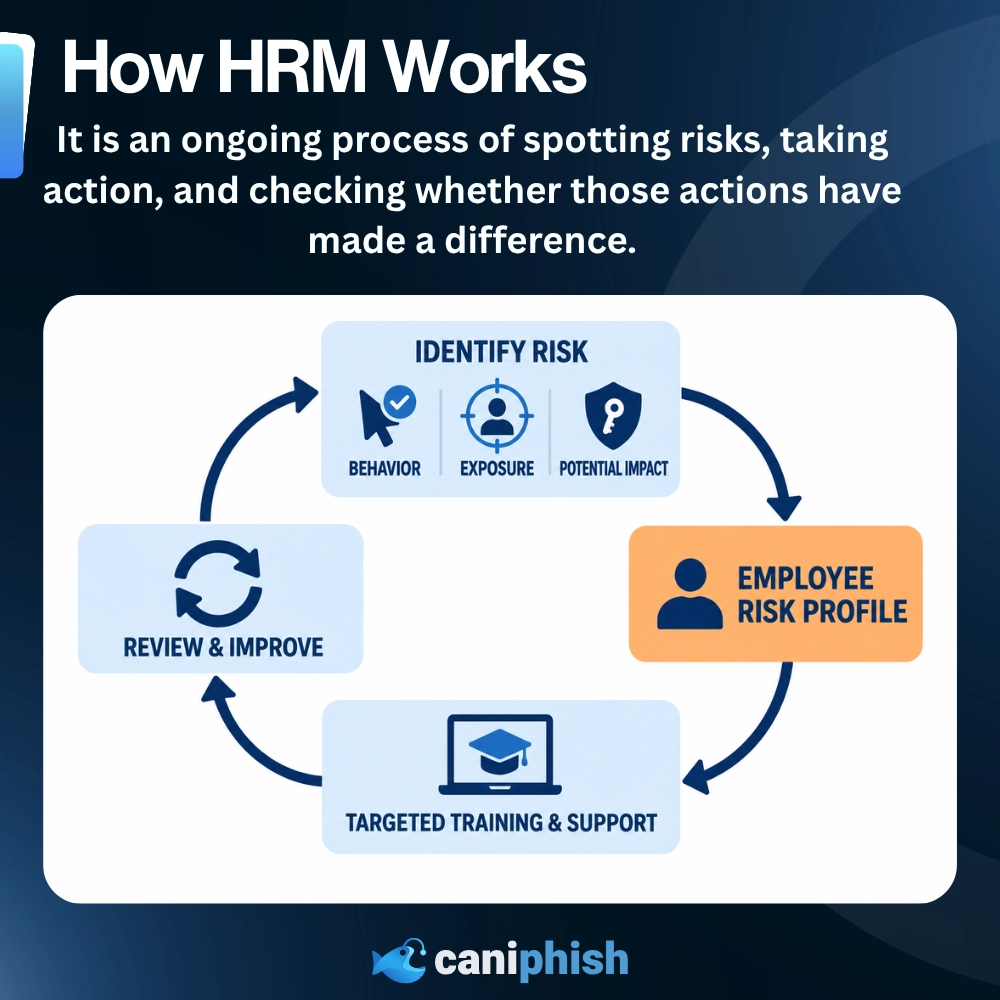
Human risk management works by understanding where people-related security risks exist within an organization.
In practice, HRM usually considers three broad areas:
- Behavior: How an employee responds to security threats and follows security procedures.
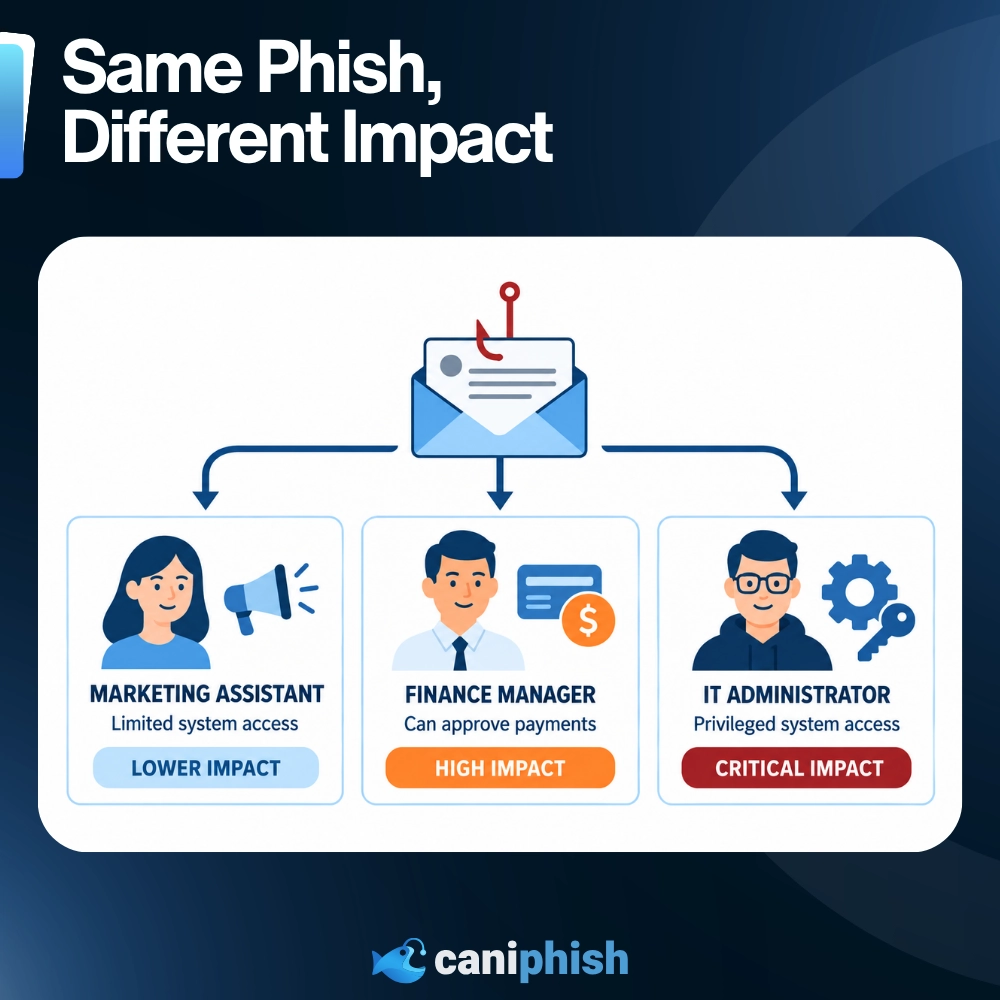
- Exposure: How likely that person is to be targeted because of their role or responsibilities.
- Potential impact: What information, accounts, or systems could be exposed if something went wrong.
By combining these three factors, businesses can create a risk profile or score for each employee. A risk score helps businesses understand who may need additional support.
As risks change, businesses can see who is at higher risk than others and assign the appropriate training.
It is a continuous cycle of identifying risk, responding to it, and checking whether that risk has improved.
Why Human Risk Management Matters In 2026
For years, many businesses have tackled employee security risks by making sure everyone ticked the same boxes: annual training, maybe a quiz here and there, and the occasional phishing simulation.
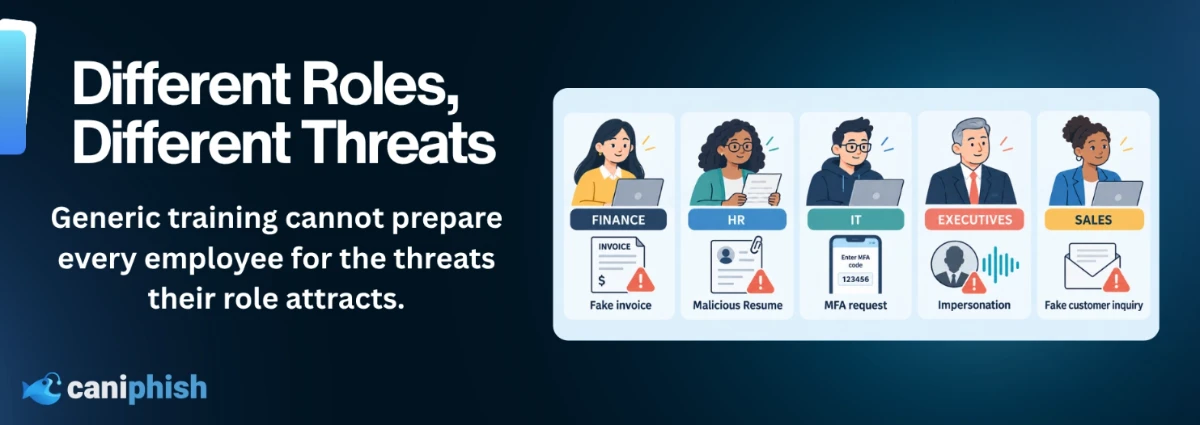
The issue with that is everyone shouldn’t get the same generic training. It should be tailored to the department they work in. The threat needs to reflect something they would actually face in the real world. So the legal team wouldn’t face the same threats as admin staff.
Risk is subject to change over time too. People get promoted and get access to more sensitive data, they could change roles and be exposed to new threats that they haven’t been trained for.
Verizon’s 2026 Data Breach Investigations Report found that common causes of breaches continue to involve the human element, including phishing, social engineering, and stolen credentials.
Human risk management gives businesses a way to respond to these differences. Instead of treating everyone the same, they can identify where the greatest risks are and provide more relevant training, stronger controls, or additional support.
People will always make mistakes. That’s just being human. The important thing is making sure employees are actually learning from their mistakes.
Human Risk Management vs Security Awareness Training
Security awareness training is one part of human risk management. It teaches employees how to recognize and respond to cyber threats through training courses, phishing simulations, quizzes, and short reminders about safer security habits.
Human risk management looks at the bigger picture.
It brings together information about employee behavior, access, responsibilities, reported threats, training results, and security incidents to identify where risk is highest. The business can then decide what action is actually needed.
Security awareness training is therefore important, but it is not the whole strategy. Training builds knowledge, while human risk management uses a wider range of information to decide where support and protection are needed most.
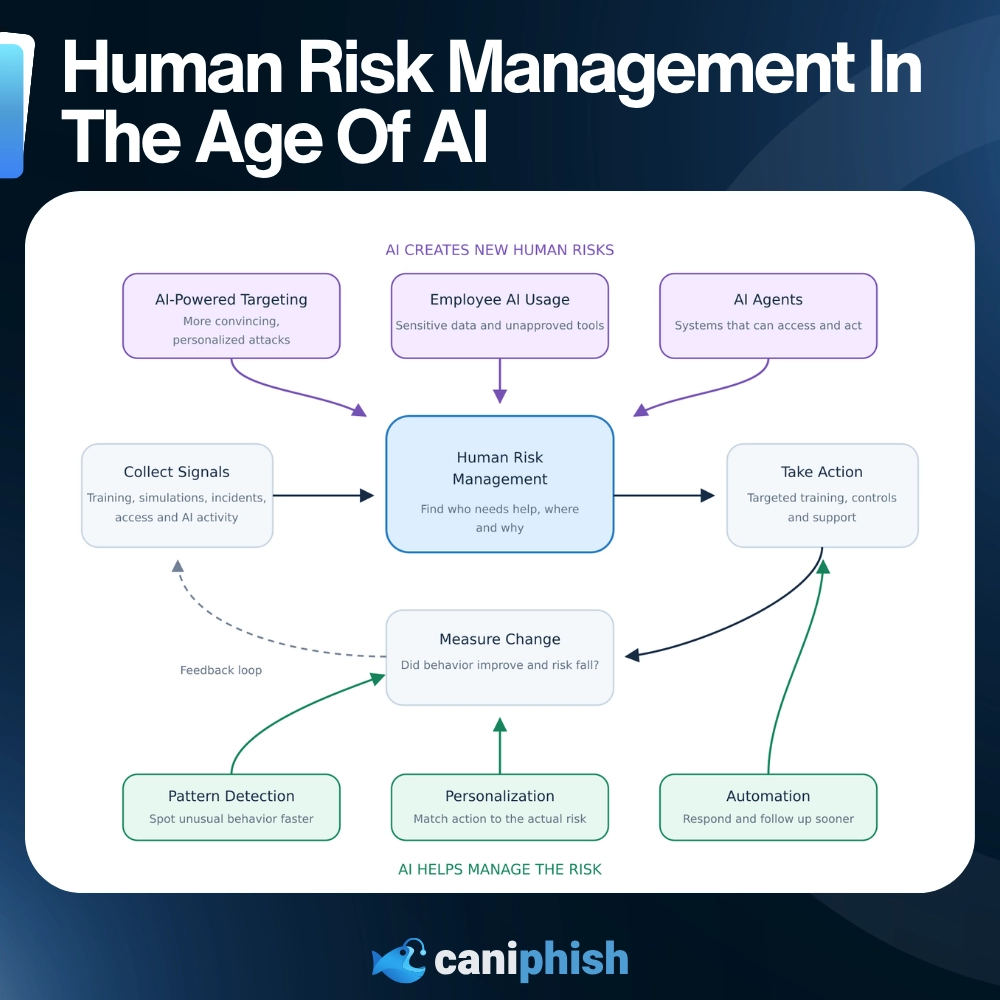
How AI Is Changing Human Risk
AI has not removed people from cybersecurity. It has simply changed the decisions they make, the threats they face, and how quickly things can go wrong.
Here are three ways AI is changing human risk.
AI-Powered Targeting
Attackers no longer need to send the same badly written email to thousands of people and hope someone clicks.
AI can help them research employees, personalize messages, imitate writing styles, translate scams, and respond naturally during a conversation. It can also be used to create convincing voice recordings, images, and videos of people the victim knows.
This makes familiar advice like “look for spelling mistakes” far less useful. Unfortunately, the scammers have discovered spell-check.
Employees now need to question the request itself. Does it make sense? Is the urgency genuine? Would this person normally ask for money, passwords, or sensitive information through this channel?
Employee AI Usage
AI tools can save employees plenty of time. They can summarize documents, write emails, analyze information, and help with whatever task someone has been avoiding all morning.
The risk depends on what employees put into those tools and how they use the answers.
An employee may paste in customer records, source code, financial information, or an internal strategy document without checking whether the tool is approved. They may also accept an inaccurate answer because it sounds confident and saves them from doing the research themselves.
Human risk management must therefore consider which AI tools employees use, what information they share, and whether important outputs are being checked before someone acts on them.
AI Agents
AI agents take things a step further. Instead of simply answering a question, they can perform tasks using connected business systems.
Depending on their permissions, an AI agent may be able to read emails, retrieve files, update customer records, schedule meetings, or send messages on an employee’s behalf.
That can be incredibly useful, but broad access also creates broader risk. Giving an AI agent permission to access everything because it might need it is the digital equivalent of handing over the master key and hoping for the best.
Businesses need to control what agents can access, monitor the actions they take, and require human approval before sensitive or irreversible tasks are completed.
How AI Can Help Manage Human Risk
Most organizations already collect plenty of information about employee risk. The difficult part is turning scattered information into a clear picture of employee risk.
AI can help sort through this information, spot patterns, and bring the most important risks to the surface. For example, it may notice repeated phishing failures, unusual login activity, or an increase in attacks targeting one department.
This can help security teams decide who needs a training refresher, whose access should be reviewed, and where stronger controls may be needed.
AI should support these decisions, not make them alone. A risk score does not always tell the full story, so human judgment is still needed before any action is taken.
The Risks Of Using AI To Score Employees
A human risk score is useful to know, but should never become a digital label stuck to an employee.
AI can only spit out a risk score based on the information it has been provided, and that might not paint the whole picture. For example, someone who reports phishing emails may appear more active than someone who ignores them entirely.
Scores can also be influenced by incomplete or inaccurate data. For example, a new employee might receive a higher risk score just because they’re new. And someone in a heavily targeted role may automatically get a higher score for reasons that have little to do with how careful they are.
Privacy can be a concern, too. Monitoring employees' login, clicks, messages, and AI quickly goes from security to surveillance. Staff should know what information is being collected, why, and who can access it.
A human risk score should only be used as a guide towards making security decisions. It can highlight who needs extra training or where additional support may be needed.
Which Human-Risk Metrics Should Businesses Track?
Businesses do not need to measure everything just because a dashboard gives them the option.
The most useful metrics include:
- Phishing behavior: Who clicks, enters information, opens attachments, or reports the message.
- Reporting rate and speed: How often employees report suspicious activity and how quickly they do it.
- Repeat behavior: Whether the same mistakes continue or improve after training.
- Training results: Whether employees complete the training, understand it, and remember it later.
- Access and exposure: Which employees have access to sensitive systems, and how often their roles are targeted.
- Security incidents: How often employee actions contribute to real incidents or near misses.
- AI-related risk: The use of unapproved AI tools, sensitive information being shared, or unchecked AI-generated answers being used for important work.
- Changes over time: Whether risk is going up, coming down, or stubbornly refusing to move.
It’s all about improvement. These metrics should be tracked together to get the full picture. The aim is to measure safer behavior, not collect numbers for the sake of having more numbers.
Frequently Asked Questions
What is human risk management in cybersecurity?
Human risk management is a cybersecurity approach used to identify, measure, and reduce risks connected to people’s actions and decisions. It helps businesses understand where human risk is highest so they can provide the right training, support, and security controls.
Why is human risk management important?
Human risk management helps businesses find and reduce risks before one mistake becomes a much larger security incident. It also allows training and security controls to be matched to the real threats employees face, rather than treating everyone exactly the same.
What does a human risk score measure?
A human risk score estimates someone’s level of cybersecurity risk based on their behavior, exposure to threats, and the potential impact if their account or device is compromised. It may take other things into consideration, such as their role, system access, phishing simulation results, training history, and involvement in previous security incidents.
Is human risk management the same as security awareness training?
In short, no. Security awareness training teaches employees how to recognize and respond to threats. Human risk management goes further by using information about behavior, access, exposure, and security incidents to decide where training, support, or stronger controls are needed.