8 Metrics To Track Engagement For Security Awareness Training

Are you looking for better ways to measure engagement in your security awareness training?
In this blog, we're breaking down 8 useful metrics that show whether your employees are actually paying attention, and not just quickly clicking through it because they were told to. But let's be honest, a completed training module doesn't mean anything stuck. It could mean they learned something. It could just mean they clicked "next" 14 times while thinking about what to eat for lunch.
Here are some practical metrics that can help you improve awareness, reduce risky behavior, and get more out of your security awareness training.
Let's dive in.
Why Engagement Metrics Matter
A lot of companies still judge security awareness training on one thing: completion rates.
Did everyone finish it? Great. Box ticked. Compliance team happy? Yes. On paper, everything looks lovely.
The problem is, you do not know who actually paid attention, who understood the material, or who changed their behavior afterward. All it tells you is that the training exists and people completed it.
That is why engagement metrics matter.
They tell you what is working, what is not, whether the training is landing, and where people are tuning out. They give you something far more useful than a completion spreadsheet. They give you insight. Because if no one is engaging with the training, it is not building awareness. It is just another expense.
1. Training Completion Rate
Start with the obvious one.
The training completion rate tells you how many employees finished the assigned training. It is the baseline metric, and yes, it does still matter.
If staff aren't even completing the training program at all, you have a problem before you even get to retention, engagement, or behavior change. Low completion usually points to issues with timing, relevance, communication, or the training ithat is too easy to ignore.
That said, don't treat this like your hero metric.
Completion just tells you that they reached the end. It does not tell you whether they learned anything. An employee can finish a training module quickly and retain almost none of it.
So yes, track completion rate, just don't stop there.
2. Training Completed On Time
This one is more useful as it adds urgency and context.
On-time completion rate measures the percentage of employees who completed their training within the expected timeframe.
Why does this matter?
When participation is completed on time, it's usually a better indicator of engagement than delayed participation. If people are completing training when it is assigned, it suggests the content is being taken seriously. It's when training gets pushed aside, ignored, or left until the deadline starts breathing down their neck that you know engagement is slipping.
It also helps you spot friction in the program.
For example, if your completion rate is high but on-time completion is terrible, that could indicate that your training is too easy to put off, badly timed, too long, or just not engaging enough to hold their attention.
3. Quiz Participation Rate
This is a more useful signal than basic completion alone.
It shows how many people are engaging with the training content by attempting the quiz, knowledge check, or any other assessment at the end.
Quizzes are naturally more engaging than passively clicking through slides. They make people stop, think, and respond. That is a lot more useful than someone reaching the end of a module on autopilot.
Even if they are not enthusiastic about it, at least the quiz forces some level of interaction. They have to read, understand, and choose an answer. That gives you a much better signal than completion alone.
If quiz participation is low, that tells you something important. People may be clicking through the training without meaningfully engaging with it.
4. Quiz Scores And Knowledge Retention
If quiz participation shows that people interacted with the content, quiz scores help show whether any of it was actually understood. This metric gives you a clearer picture of whether the training is sinking in.
This can be measured in several ways.
- Average quiz score
- Pass rate
- Improvement over time
- Performance in later follow-up assessments
That last one matters the most.
Security awareness isn't about passing a quiz on a Wednesday but then forgetting everything by the weekend. The real goal is retention. Can your staff remember what they learned later when they face a suspicious email, a fake login page, or an odd request from someone pretending to be the CEO?
That's where the training either proves its value or falls short.
5. Ongoing Training Engagement
Completing one module doesn't mean your program is solid.
This metric shows whether employees keep showing up after the first round of training. That matters because one module is not enough. Better security habits take time and repetition.
This metric helps show whether engagement is building or fading.
If participation levels drop off after the first round, then that's an indication that the content is repetitive, stale, or people are checking out because it all feels too familiar.
On the other hand, if people keep showing up and engaging across multiple sessions, that is a much better sign that the program has momentum. It is becoming part of the culture rather than something they complete once and forget about.
6. Badge Or Achievement Progress
This is where things start to get fun.
If your security awareness program includes badges, milestones, or achievements, they can serve as useful engagement metrics.
Badges usually reflect action. Passing quizzes, completing modules, reporting phishing emails, taking part in challenges, and staying consistent. These all create a sense of progress, and that matters more than people think.
When employees start chasing badges or unlocking achievements by choice, it suggests that the training has moved beyond obligation. And that's what you want.
It means they're not finishing a task because they have to. They are engaged enough to care about the outcome, even if only slightly. That kind of motivation is far more useful than passive compliance.
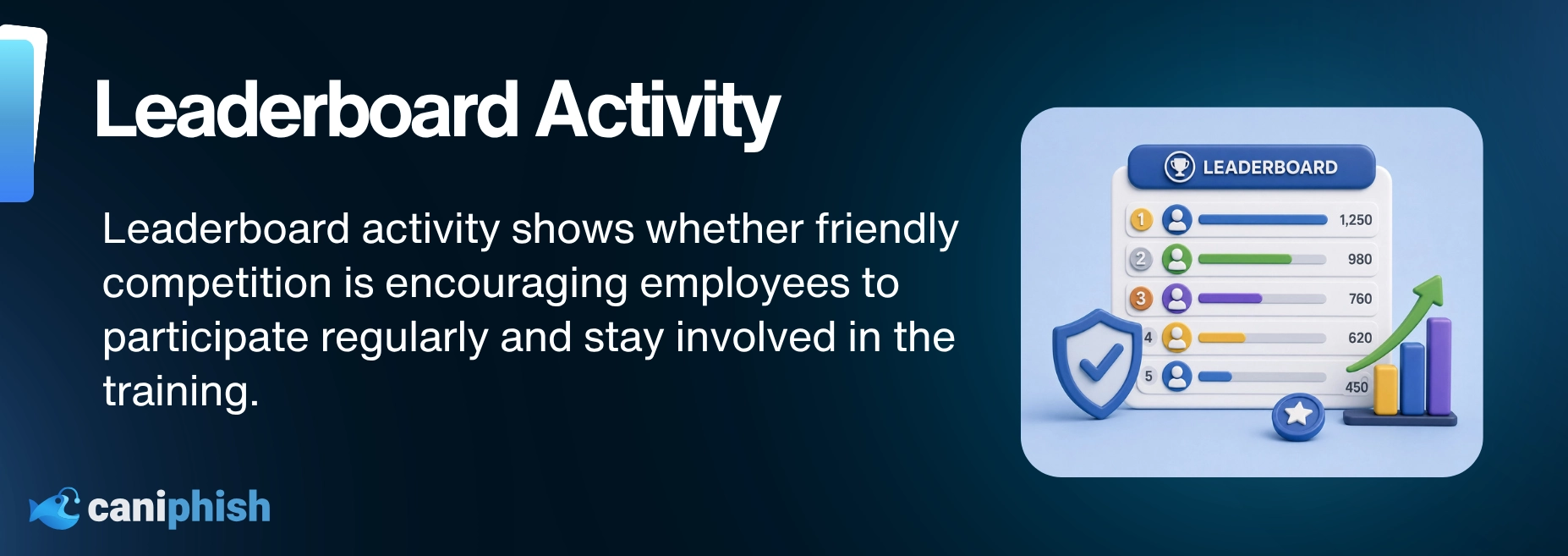
7. Leaderboard Activity
Leaderboards can be a surprisingly useful way to track engagement, especially when done well.
They give you and your employees a visual signal of recurring participation. If staff are earning points, participating regularly, and interacting often enough to move on the leaderboard, that tells you that they are engaged in a way completion stats alone will never show.
Leaderboards can also help create friendly competition, which is often exactly what security awareness training needs. Not everyone is going to get excited about phishing modules on their own. But tell them "Let's see if you can beat John from accounting!" and all of a sudden things get more lively.
That being said, if it starts to feel like public shaming or it embarrasses low performers, it can do more harm than good. The goal is to encourage participation, not to create a digital wall of shame.
Used properly, leaderboard activity can be a strong signal that your employees are not just present for the training, they are actively involved in it.
8. Voluntary Participation In Extra Content
This is one of the best engagement metrics because it shows that interest is genuine, not forced.
Voluntary participation measures how employees choose to engage with optional awareness content, not just the training they were assigned. That might be doing bonus modules, checking out extra phishing examples, revisiting past lessons, joining mini challenges, taking part in Cybersecurity Awareness Month activities, or exploring more content on their own.
This matters because genuine engagement is much harder to fake than mandatory completion.
If employees are voluntarily clicking into extra content, that usually means one of two things. That the content is genuinely useful. Or your incentives are doing their job. Either way, it's a win-win.
It also helps you identify which topics people are most interested in. If employees keep choosing optional content on phishing, remote working, or AI-related scams, that suggests those areas feel more relevant or useful to them.

Wrapping Up
So there you have it, eight useful metrics to track. Together, they can help you see whether employees are actually engaging with your security awareness training, not just racing through it to make the nagging emails stop.
If you want to know whether your training is working, you need the full picture.
So give these metrics a proper look. Who completed the training? Who took part in the quizzes? Who went beyond the bare minimum by earning badges, climbing the leaderboard, or exploring extra content?
Because the goal isn't just to prove the training happened. It's to know whether it worked and whether people learned from it.

The Top 13 AI Documentaries In 2026
Uncover the dark side of artificial intelligence, minus the Hollywood lasers.
Check out our top picks
An Operations Analyst on a mission to make the internet safer by helping people stay a step ahead of cyber threats.