
Are you trying to choose a security awareness training platform without getting buried in feature lists, vague promises, and platforms that look good in a demo but are a pain to actually use?
In this blog, we’re breaking down 10 must-have criteria to look for in a security awareness training platform, so you can choose one that fits your team, keeps your employees engaged, and does more than just dish out training for the sake of it.
It’s important to find the right platform because a good platform should help people learn, spot threats more confidently, and build safer habits over time.
Let’s dive in.
1. Engaging Content
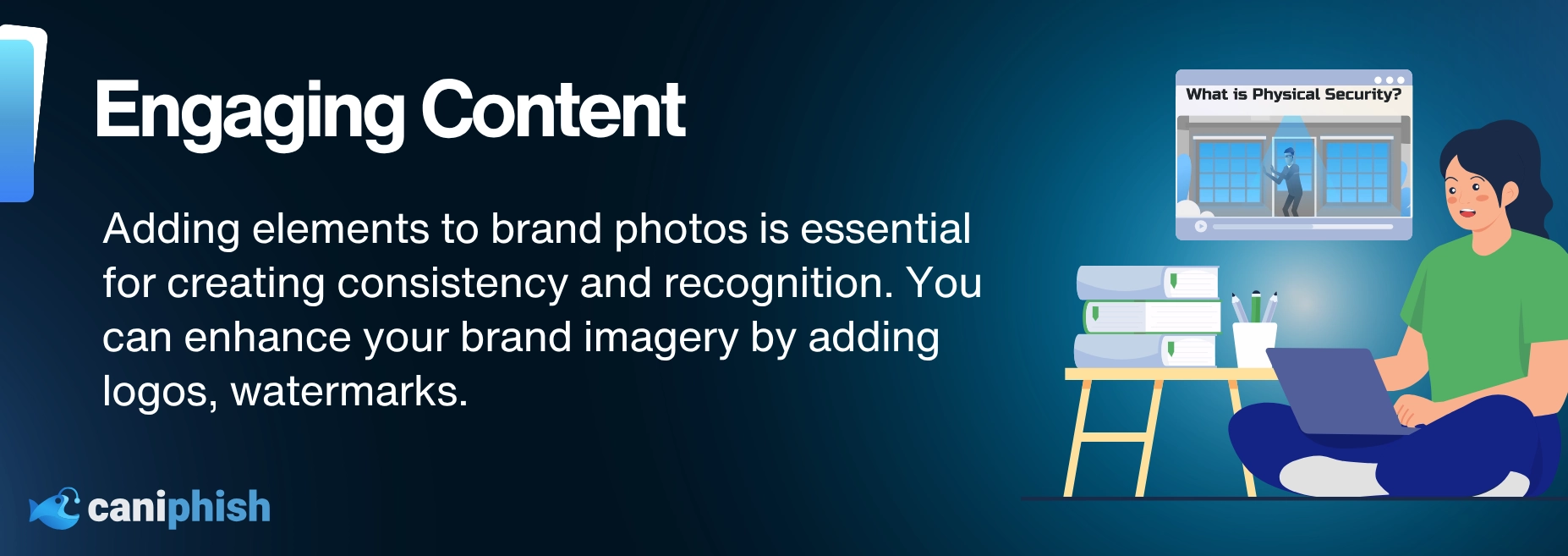
This is one of the more important ones because if your training content is boring, outdated, or sounds like it was written by a compliance robot, people switch off... fast. Sure, they’ll complete it, because they have to. But mentally, they were somewhere else. So very little actually sinks in.
That’s why having engaging content matters. Something they can relate to and actually understand.
A good security awareness training program should make the material relevant to real life, easy to follow, and interesting enough that they actually pay attention. That means short modules, realistic and relatable examples, strong visuals, and a tone that keeps the reader awake. And while security is a serious topic, that doesn’t mean the content has to be painfully dry. A little humor and personality can go a long way. If something gets a quick chuckle, it’s usually more memeable than a wall of lifeless corporate text.
2. Realistic Phishing Simulations
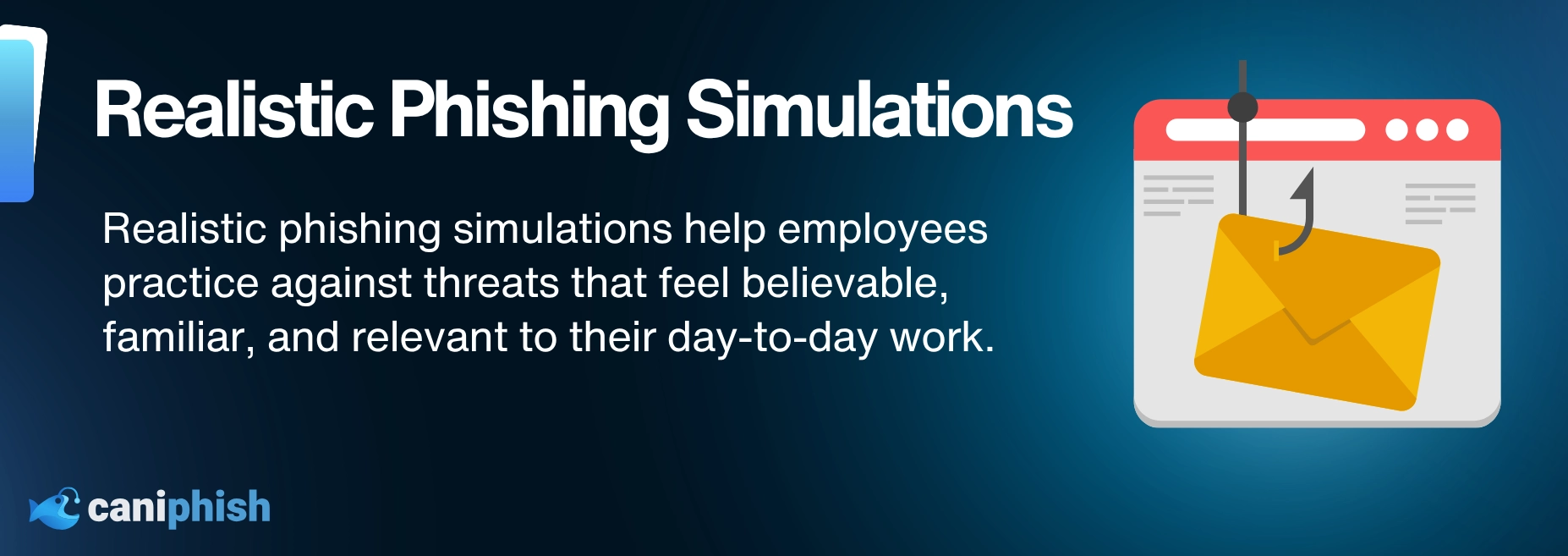
Phishing simulations are among the most useful components of a strong security awareness training program. For most employees, phishing is the risk they are most likely to run into during a normal workday.
Simulations give employees the opportunity to practice safely before a real threat lands in their inbox. Training tells employees what to look for, but simulations show whether what they’ve learned has stuck. Because hoping everyone remembers the training is nice, but not exactly a security strategy.
An effective platform should let you run phishing simulations that reflect the threats your employees could realistically face. That means believable lures, brand impersonation, different difficulty levels, and a mix of attack styles that match what people are used to seeing at work.
If the simulation sticks out like a sore thumb, the results will not tell you much. You are just teaching employees to spot lazy bait, which your email filters may already catch, not modern phishing.
White labeling is also a key component to look for, especially when it comes to remedial training. It allows the training experience to be branded to your organization, so follow-up lessons feel like part of your internal security program rather than a disconnected third-party platform.
That matters because remedial training is often delivered after someone has interacted with a simulation. The experience should feel familiar, trusted, and connected to the tools employees already use, not like they have been redirected to a mystery portal from planet “Who Approved This?”
3. Customization Options
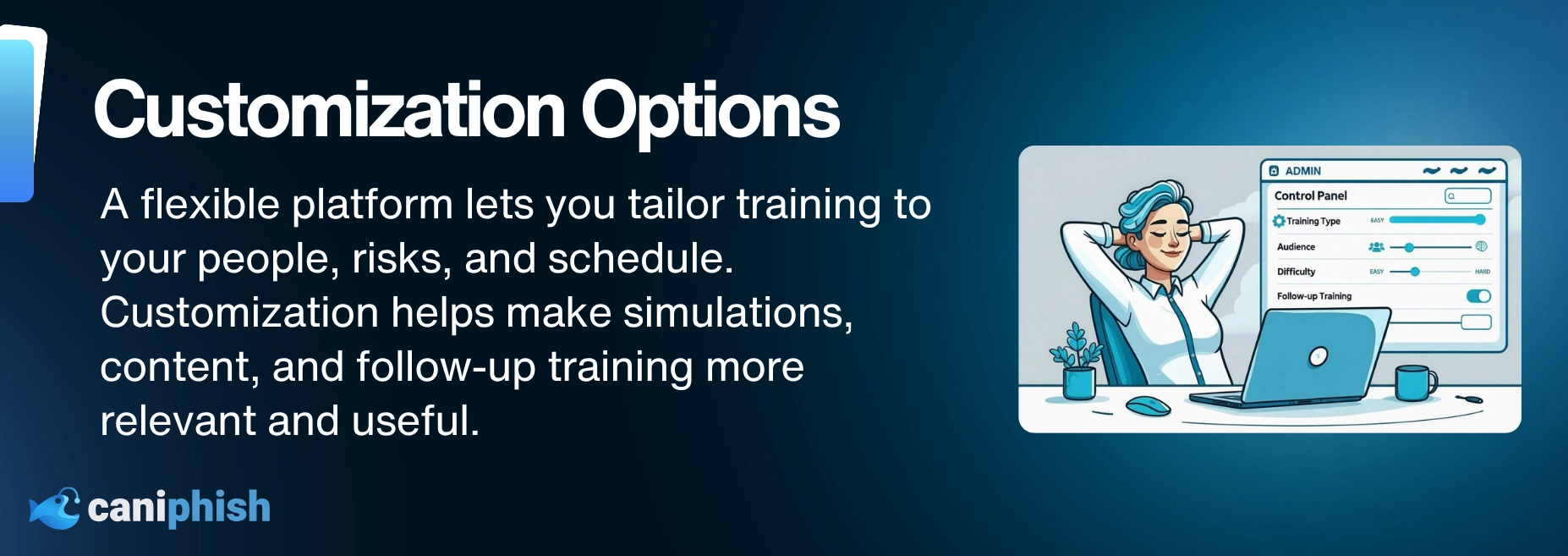
Customization plays a key role because not every employee needs the exact same training at the exact same time. A good security awareness training platform should let you choose what training goes out, who receives it, and when it gets delivered.
That could mean assigning different topics to different departments, changing the training frequency, branding the content to your organization, or giving extra support to higher-risk roles.
This should also extend to phishing simulations. The platform should let you adjust the type of simulation, the difficulty level, the attack style, the landing page, and the follow-up training employees receive after the test. That might be a simple phishing email, a more advanced conversational phishing scenario, or targeted remedial training for employees who need another pass at it.
If someone clicks on a simulation, the answer is not to send them off to some random training module from the corporate basement. The follow-up should match what they actually missed, while the moment is still fresh enough to mean something.
AI is also becoming a popular feature in this space. Some platforms use AI to help create training content, build phishing scenarios, recommend follow-up lessons, or suggest which employees may need specific training based on their risk level or past behavior.
4. Role-Based Training
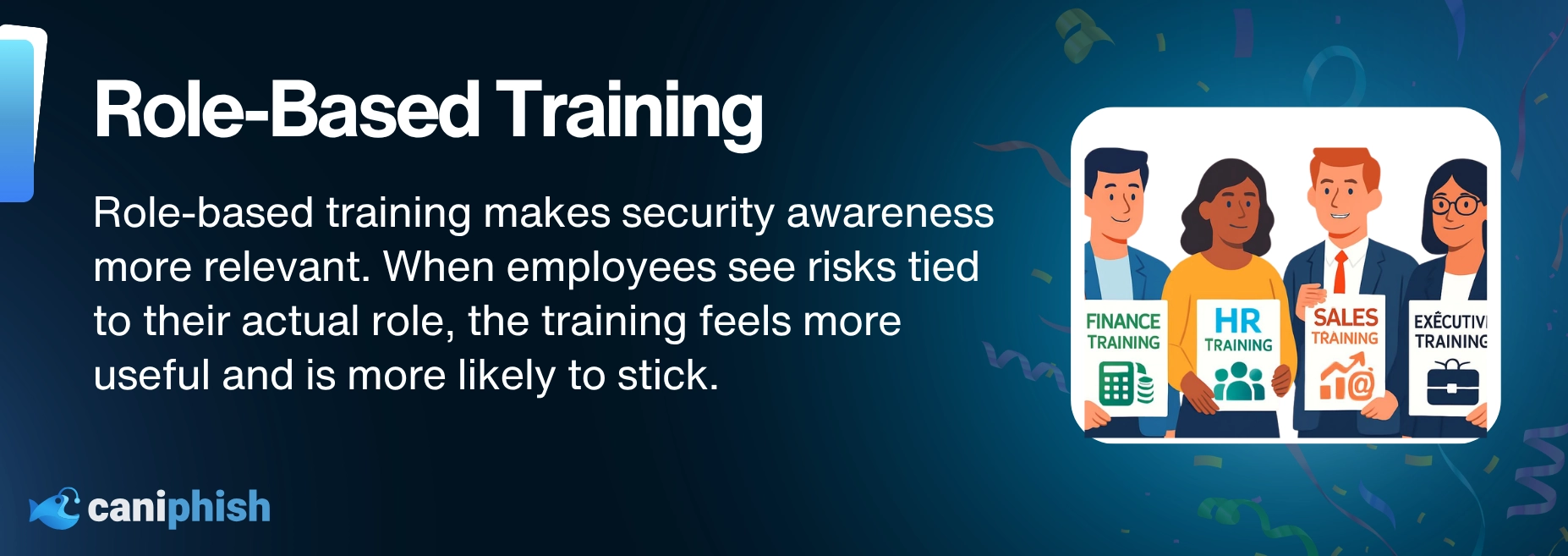
Not every employee faces the same risks, so everyone shouldn’t get the exact same training. General security awareness is useful, but it becomes far more effective when it is tailored to the people taking it.
Finance teams face different threats than HR teams. Sales teams have different exposures than legal teams. Executives face different risks than general staff.
That’s why role-based training is important.
A strong platform should let you tailor training by department, position, and risk level. Because if employees can relate to the situation, they are more likely to pay attention and take it seriously.
In practice, this could mean finance teams spend more time learning how to spot fake invoices and payment redirection scams, while HR teams need to be sharper on fake resumes, payroll changes, and suspicious requests for employee data.
That is what stops training from feeling generic and turns it into something employees can actually use in their day-to-day work.
5. Continuous Training
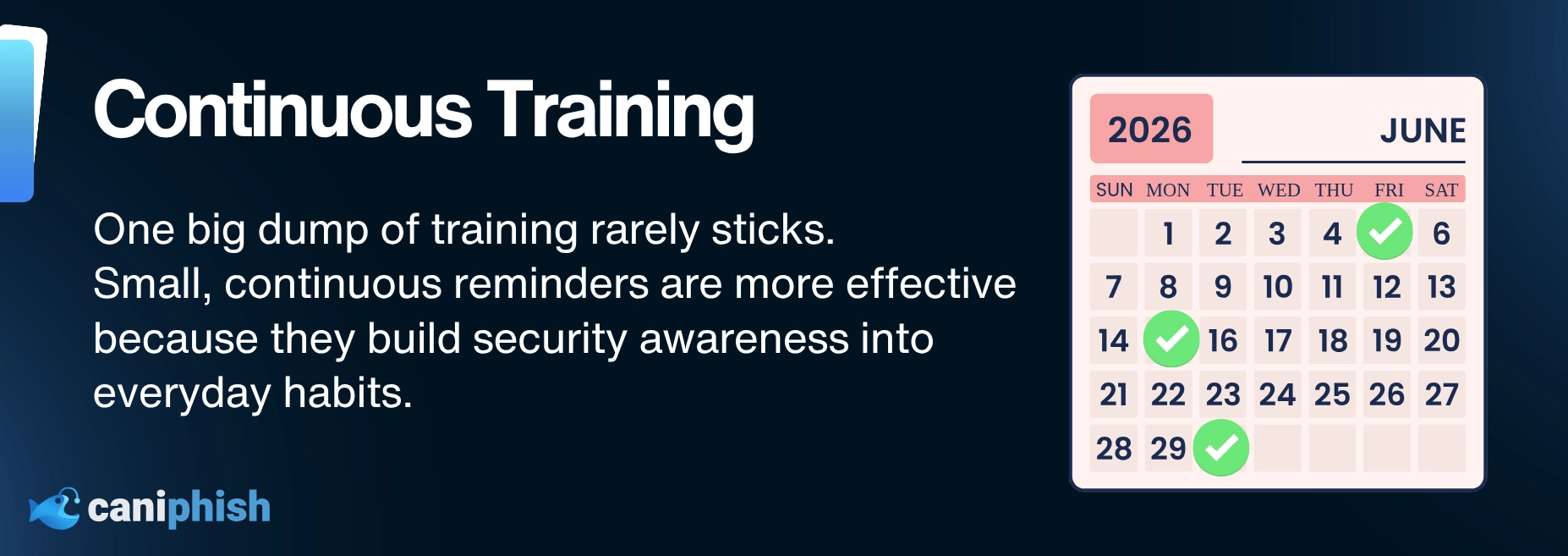
Security awareness training should not be treated as a once-a-year event. People remember things better when they are reminded regularly in simple, practical ways.
Dumping a huge amount of training on staff might feel like you’re ticking the compliance box, but it does not always stick. Good platforms make training feel more like steady habit-building and less like cramming for an exam, where everyone forgets the answers as soon as it’s over.
It’s all about balance.
That could mean quick refresher lessons, phishing simulations, policy reminders, or examples of current threats that help employees stay up to date with the fast-changing phishing landscape.
The goal is not to overload people with constant training. It is to keep security awareness present enough that safer habits become part of the workday.
6. Strong Reporting And Useful Metrics
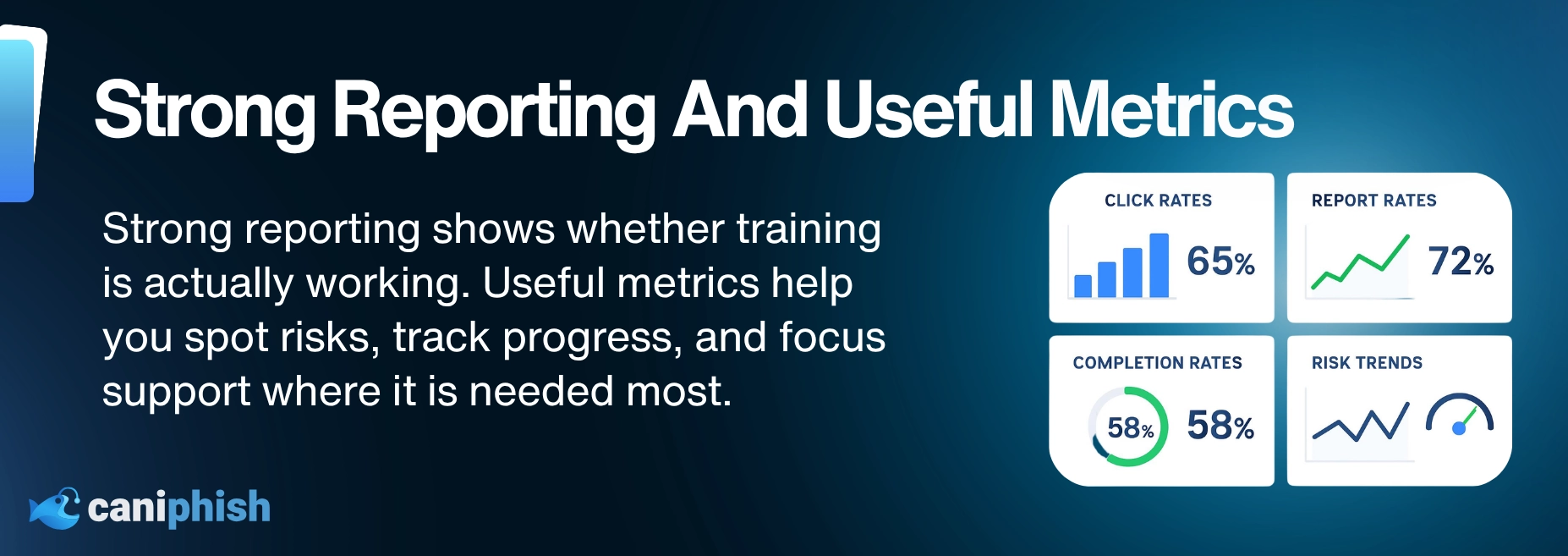
You can’t improve what you can’t measure.
Reporting is where a security awareness platform proves whether the training is working.
A good platform should help you track the things that matter, not just whether someone clicked through the training on autopilot, hit “complete,” and moved on with their day.
For training, useful metrics might include completion rates, quiz results, and whether employees are actually improving over time.
For phishing simulations, useful metrics might include click rates, report rates, repeat clickers, department trends, and whether people are getting better at spotting and reporting suspicious emails.
This matters because reporting should help you make better decisions. It should show where your organization is improving, where risks still exist, and which employees or teams may need extra support.
7. Easy Administration And Automation
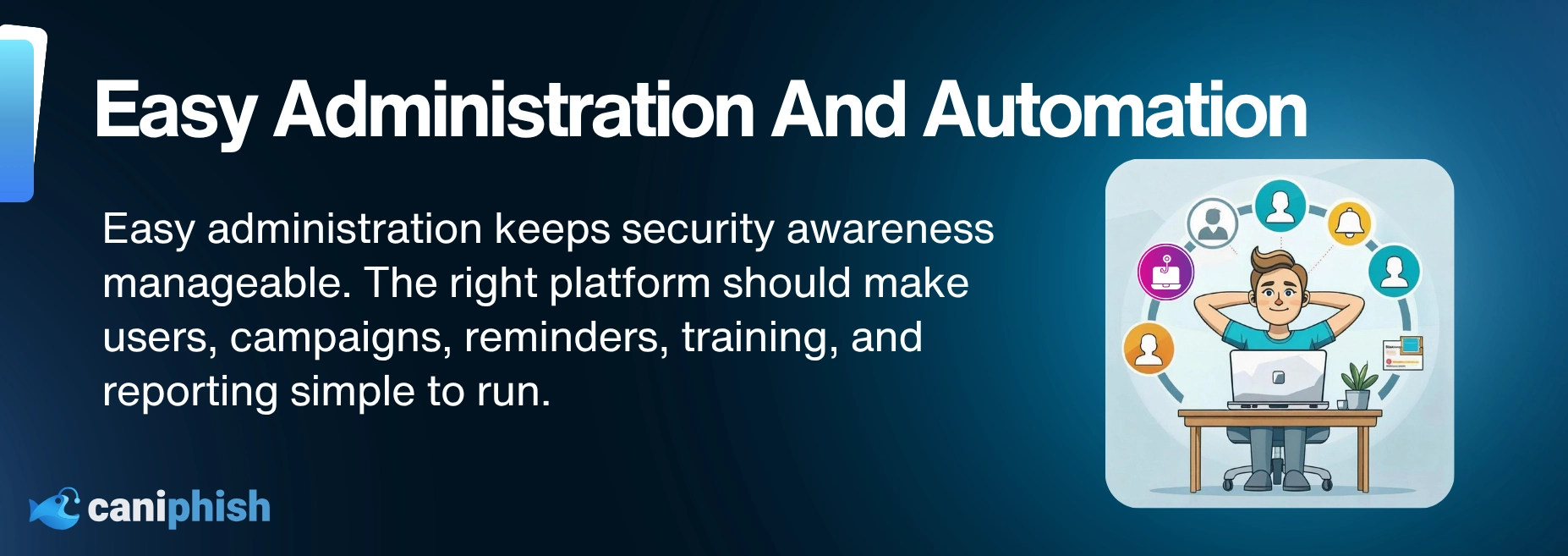
This is where things can make a real difference. If a platform is not user-friendly or easy to maintain, your team is not going to look forward to using it. An ideal platform should make management feel simple, not like another job on top of everyone’s actual job.
If your IT team or administrators have to manually do everything, the platform can end up creating more work than it saves. Managing a platform should make it easy to add users, schedule phishing simulations, assign training, send reminders, automate follow-up training, and pull reports without adding extra admin burden.
The strongest platforms go a step further by using AI to remove even more manual decision-making. AI-powered automation can help match phishing emails and training modules to each employee based on their role, risk level, history, and campaign goal. That means the program keeps moving without someone manually choosing every email, lesson, reminder, or follow-up step.
The easier it is to manage campaigns, reminders, training, and reporting, the more likely your team is to keep the program running properly. The real value of automation is when it reduces the need for admins to intervene at all.
8. Employee-Friendly User Experience
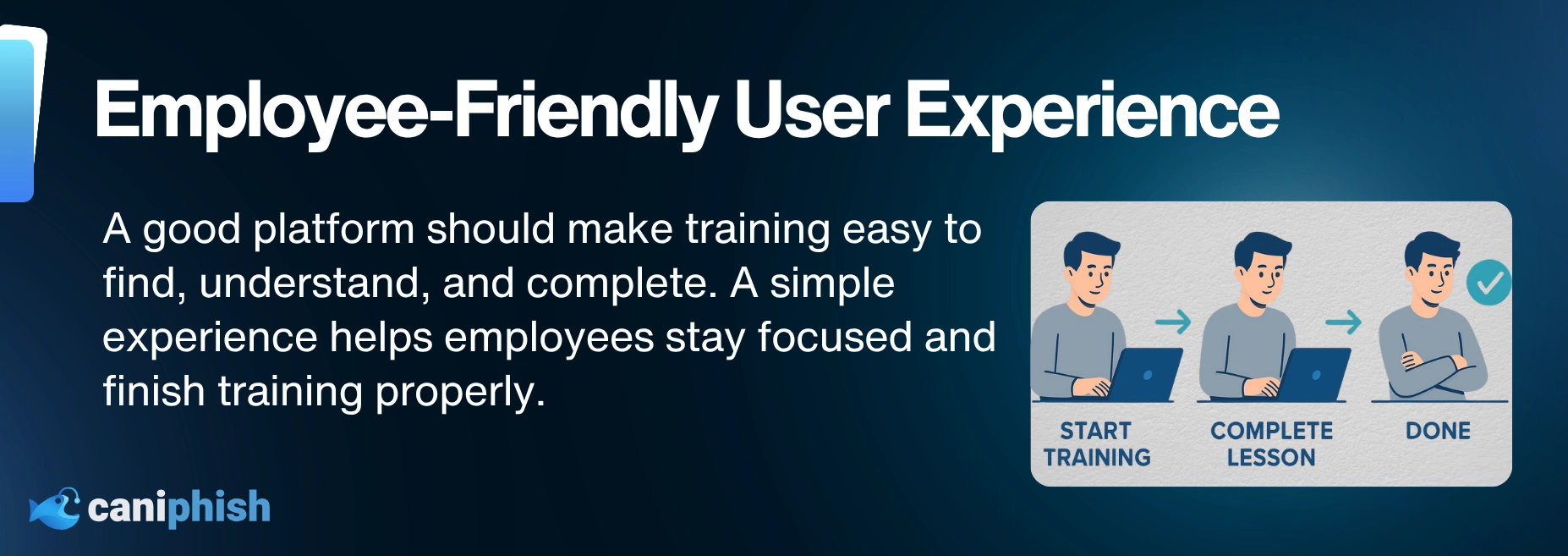
An employee-friendly user experience means the platform is easy for employees to access, navigate, and complete without confusion. If it’s hard to log in to, the training isn’t easy to follow, or the platform is painful to use, employees are more likely to put it off or avoid it altogether.
A good rule of thumb is: the training should be easy to find, easy to understand, and simple to complete.
A strong platform should also support Single Sign-On, or SSO, so employees can use the same work account they already use instead of creating another login just for training.
This is important because security awareness training depends on participation. Employees are far more likely to complete training properly when the experience is clear, quick, and painless.
The best platforms keep the experience simple. Clear layouts, short lessons, obvious next steps, accessible content, smooth completion tracking, and seamless login all help employees stay focused. When the platform gets out of the way, the message has a much better chance of landing.
9. Real Behavior Change
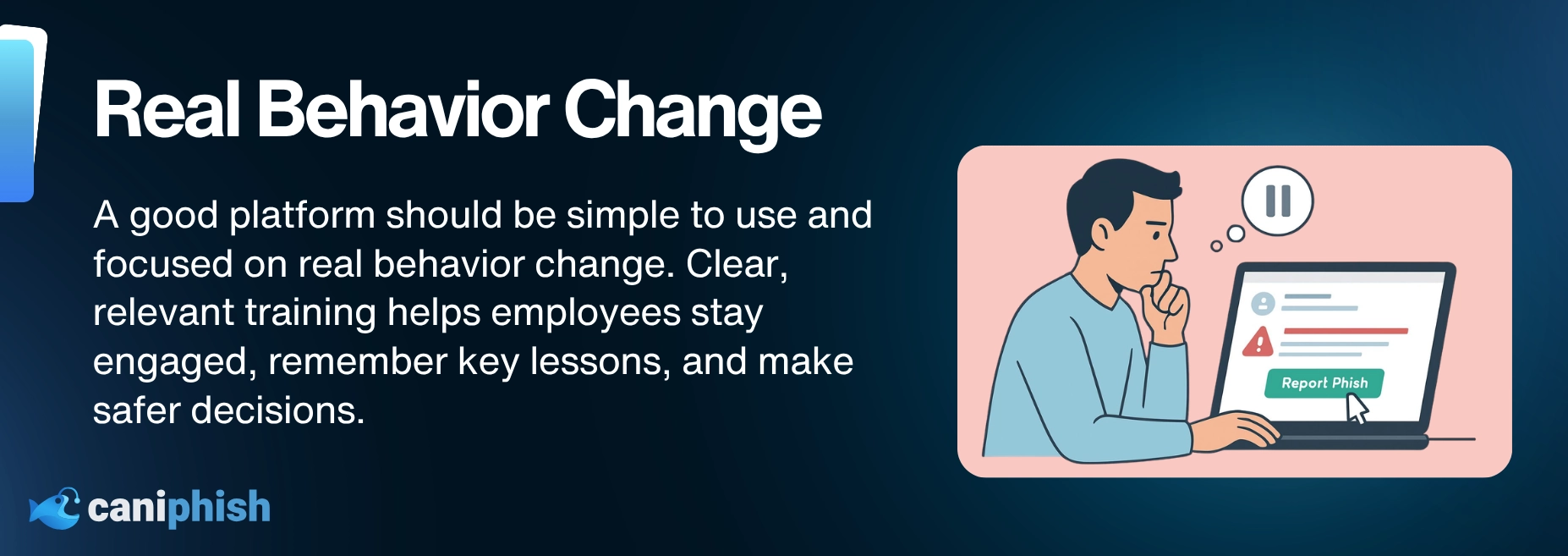
A security awareness platform should do more than just tick a completion box to show employees have finished a module. Yes, completion matters, but what matters more is whether people are making safer decisions after the training is completed.
Real behavior change means the training starts carrying over into everyday work. Employees are not just passing quizzes or completing modules, they are making better decisions when it counts.
That could be checking before sharing sensitive data, protecting a company laptop while traveling, using AI tools responsibly, browsing the web with more caution, following secure development practices, or asking for a second check before approving something unusual. Phishing is part of the picture, but it is not the whole picture.
A reliable platform should help reinforce those habits over time. If someone struggles with a topic, whether that is phishing, device security, safe internet browsing, AI usage, travel security, privileged access, or secure coding, the platform should be able to assign relevant follow-up training that helps them understand what went wrong and what to do differently next time.
Because the goal is not just to get employees through training. The goal is to help them make better security decisions when it actually matters.
10. Scalability And Business Fit
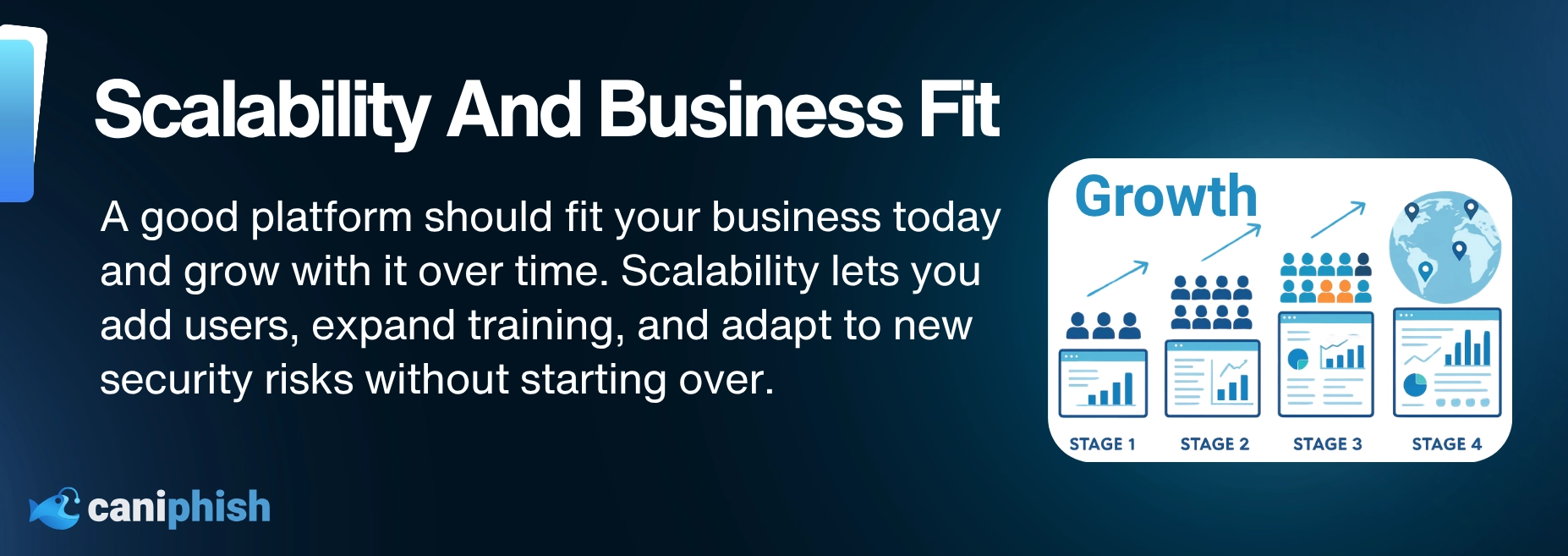
Scalability and business fit mean the platform can support your organization now, but also still make sense as your team grows, changes, or becomes more complex.
A platform might work well for a small team, but that does not mean it will work well across multiple departments, regions, roles, or office locations. As your organization grows, you may need more users, more training groups, more reporting options, more integrations, and more flexibility around how campaigns are managed.
This is important because switching platforms later can be a headache. Nobody wants to rebuild training programs, migrate users, redo reporting, and explain to leadership why the “perfect” platform suddenly needs replacing because the organization has outgrown the current platform. It should be able to adapt as your organization changes and keep up with current threats in the security awareness landscape.
The best platforms make it easy to scale without adding unnecessary complexity. They should give your team room to grow, adjust, and improve without needing to rip everything out and start again.
A Few Other Things To Consider
Aside from the main features listed above, a few practical factors can affect how well a platform fits your organization over time. They may not be deal-breakers for every team, but they are worth taking into account before you commit.
Let’s break down a few common ones.
Multilingual Support
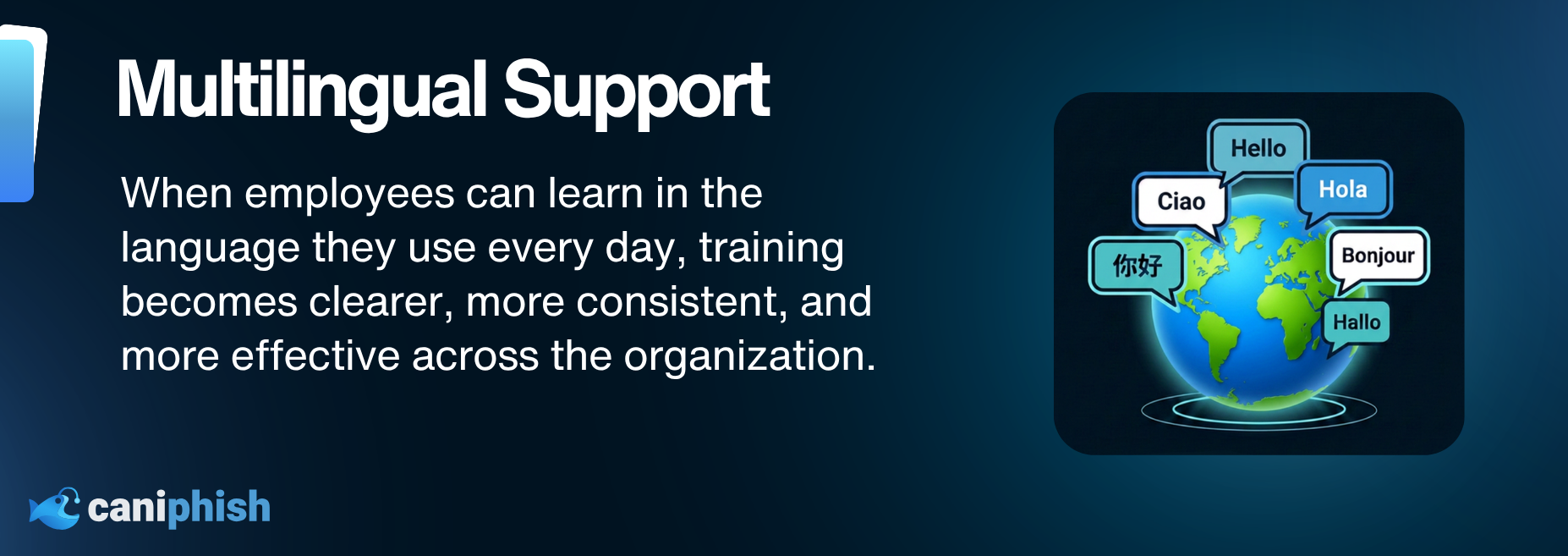
Multilingual support is important if your organization has employees across different countries, regions, or language backgrounds. Security awareness training only works if people can clearly understand what they are being taught.
The right platform should make it easy to deliver training in the languages your employees actually use. This helps keep the learning consistent across the organization, so everyone receives the same message, regardless of where they are based or what language they speak.
If employees are struggling to understand the content, they are probably not absorbing the security message either.
Accessibility And WCAG Compliance
WCAG, or the Web Content Accessibility Guidelines, is a widely used standard for making websites, apps, and digital content more accessible.
Platforms should be accessible to all employees, including those who need captions, use screen readers, or use keyboard navigation.
Different Workforce Setups
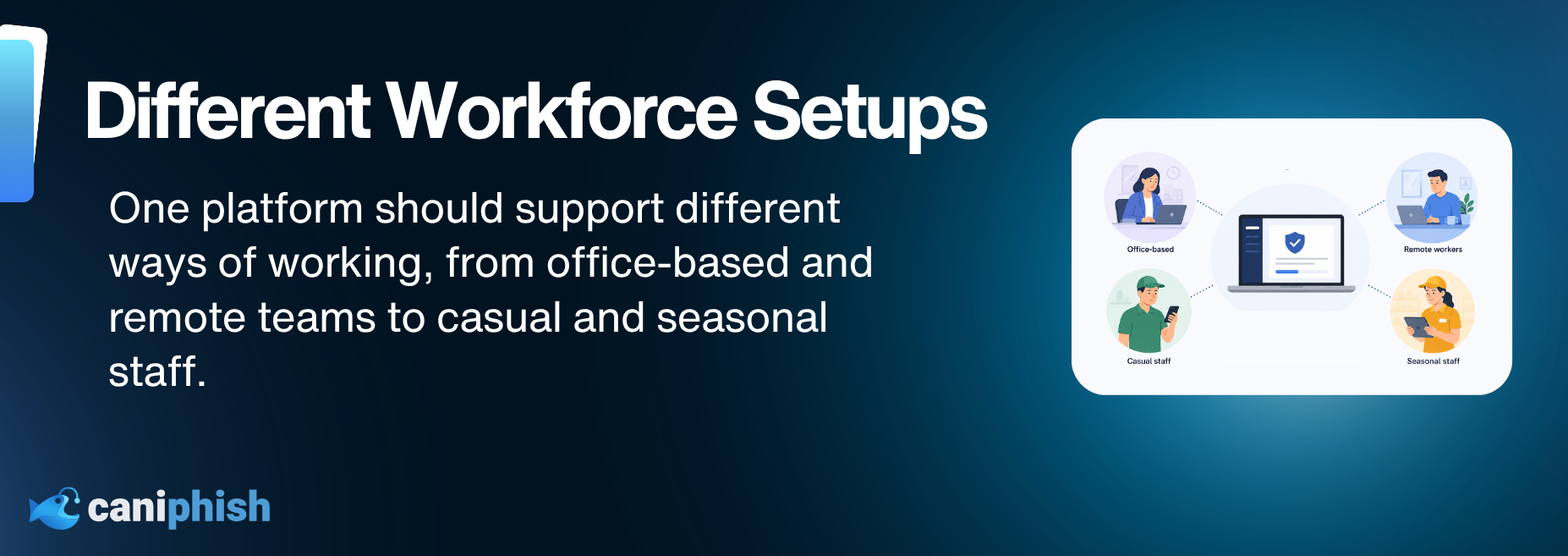
In most organizations, not everyone fits into one neat workforce setup. Some employees are office-based, some are remote, and others may be casual, seasonal, or spread across different locations.
So a good platform needs to fit how people actually work. It should deliver the same training experience while accommodating different working realities.
Wrapping Up
Choosing the right security awareness training platform means selecting one that your team can actually use properly.
The right platform should help you deliver training that is engaging, relevant, realistic, and easy to manage. It should support different roles, provide useful reporting, automate repetitive work, and give employees a smooth experience from start to finish.
Most importantly, it should help improve behavior over time.
So when comparing platforms, look past the shiny demo. Ask whether it will actually work for your people, your risks, and your business once the sales call is over and real life kicks in.
The Top 13 AI Documentaries In 2026
Uncover the dark side of artificial intelligence, minus the Hollywood lasers.
Check out our top picks
An Operations Analyst on a mission to make the internet safer by helping people stay a step ahead of cyber threats.