The 12 Most Famous AI Researchers In 2026

Are you looking for the most famous AI researchers in 2026?
In this blog, we’re counting down the 12 biggest names in Artificial Intelligence (AI) research. These are not just people who talk about AI on stage or slap it into a company bio. These are the researchers who actually helped shape the field. This list is based on impact, influence, and contribution to modern AI systems.
Let’s dive in.
1. Geoffrey Hinton
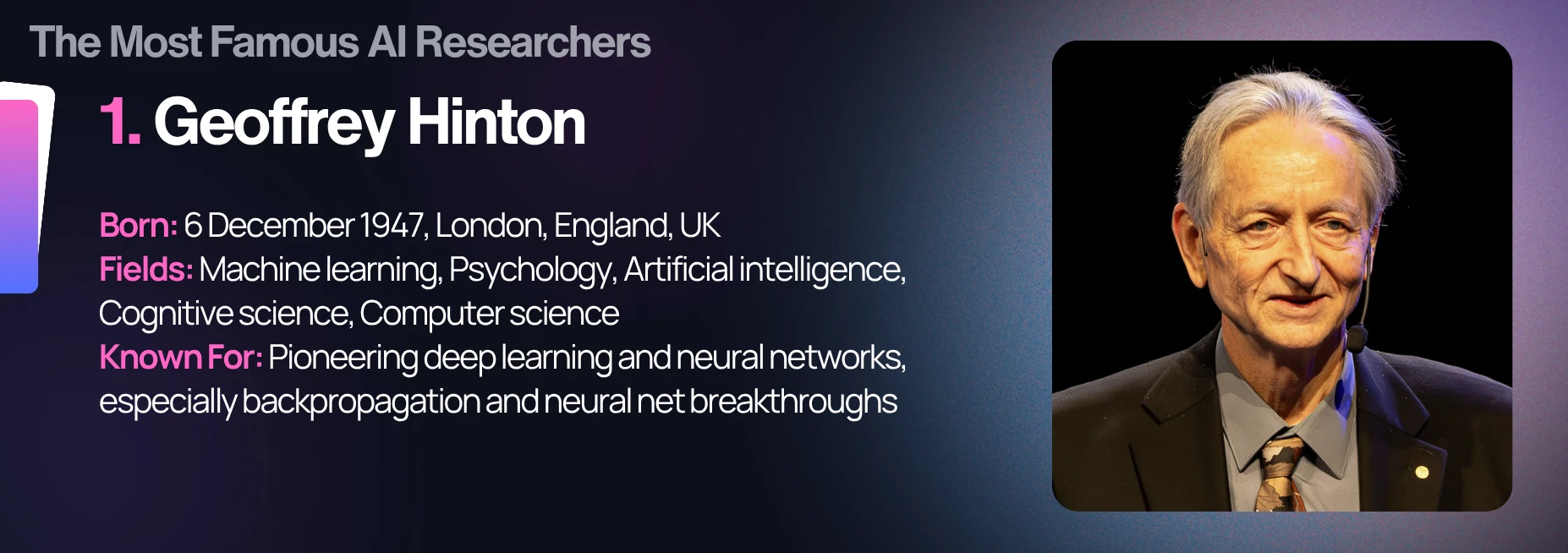
Photo: Arthur Petron, Wikimedia Commons, CC BY-SA 4.0. Cropped.
Geoffrey Hinton comes in at number one because if you remove him, half the modern AI story stops making sense.
A lot of what people now call “AI” is really neural networks scaled up and working properly, and Hinton is one of the main reasons that happened. He’s often called the Godfather of AI, and he recently shared the 2024 Nobel Prize in Physics for work associated with breakthroughs in neural networks.
His biggest claim to fame is helping push neural networks back into the spotlight when much of the field had moved on. That mattered because that approach became a major part of the technology behind today’s AI systems, including image recognition, speech tools, and large language models. In other words, while half the world is now talking about AI like it showed up overnight, Hinton was doing the hard work decades earlier.
Education and Work Background
Hinton earned his PhD in AI from the University of Edinburgh in 1978. He held long-running roles at the University of Toronto, spent time at Google, and is now University Professor Emeritus at U of T. These days, he’s also known for speaking publicly about AI risk and safety, which keeps his name in the headlines as well as the research world.
He deserves the top spot on this list because his research helped lay the foundation for the modern AI boom. This is not just a case of being early to the party. He helped build the house, wire the lights, and left the blueprints on the table for everyone else to follow.
2. Demis Hassabis
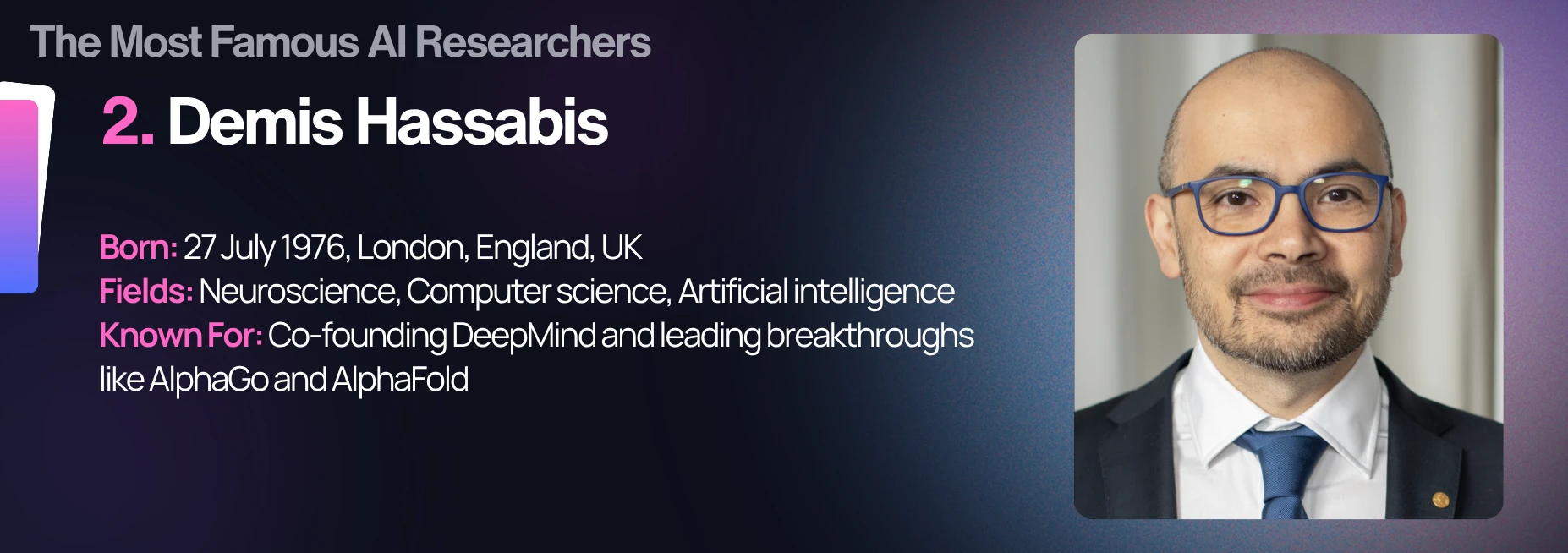
Photo: John Sears, Wikimedia Commons, CC BY-SA 4.0. Cropped.
Demis Hassabis takes number two.
AI gets serious when it stops being a clever demo and starts doing things that genuinely move the needle. Hassabis is tied to the whole “Alpha” run, where AI went from party trick to problem-solver. AlphaGo proved it could dominate a game as complex as Go. AlphaZero went a step further and learned by playing itself, which basically meant it wasn’t copying humans anymore. It was figuring things out on its own. Then AlphaFold turned the spotlight away from games entirely and into science, proving AI could help solve problems researchers have been wrestling with for decades.
Education and Work Background
Hassabis earned his PhD at UCL in 2009, and cofounded DeepMind. Today, he is Chair of DeepMind and Chief Scientist of Alphabet, which is Google’s parent company. So, in other words, he’s a big deal. He also shared the 2024 Nobel Prize in Chemistry for protein structure prediction work connected to AlphaFold.
3. Fei-Fei Li
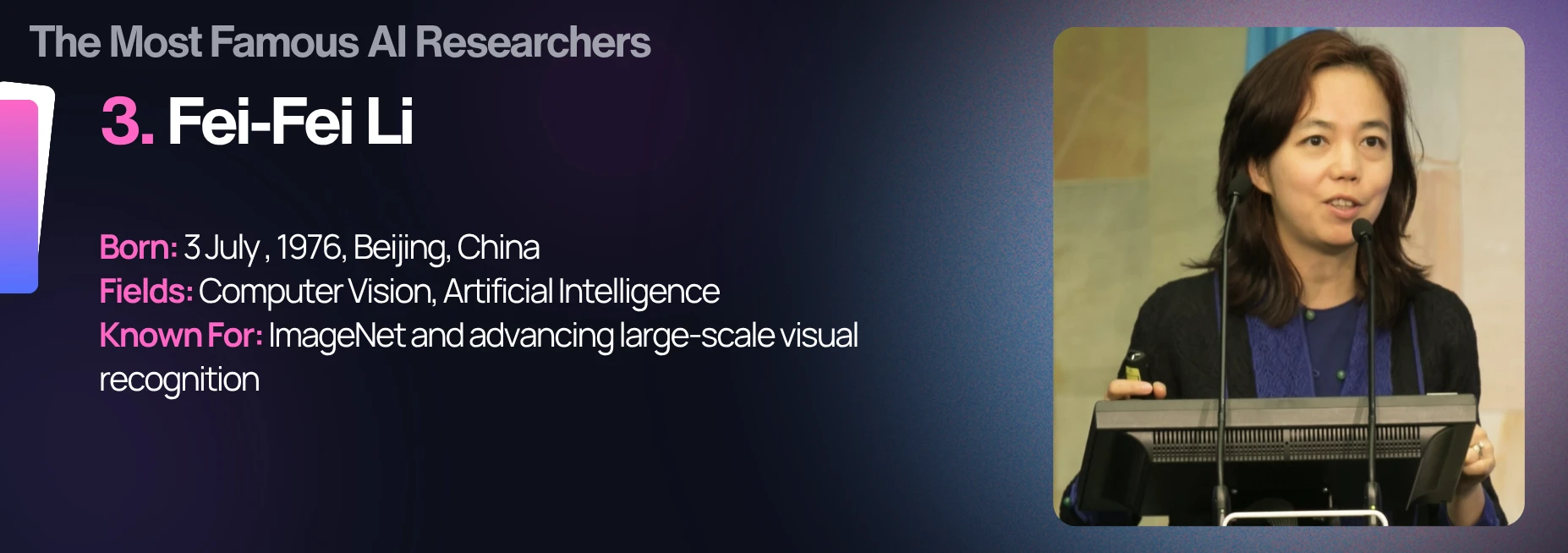
Photo: ITU Pictures, Wikimedia Commons, CC BY 2.0. Cropped.
Before AI could label your dog, spot a pedestrian, or tell the difference between a banana and a school bus, someone had to teach it how to see properly. That is where Fei-Fei Li comes in. Her work helped push computer vision into the mainstream, and ImageNet became one of the biggest reasons AI got dramatically better at recognizing what it was looking at.
ImageNet mattered because it gave researchers a huge, messy pile of real world images with labels that actually let them measure progress. Instead of “maybe the model got better,” you could prove it. And Fei-Fei Li helped make that happen, which is a big reason she’s one of the most important women in modern AI research.
Education and Work Background
Fei-Fei Li earned her PhD from Caltech in 2005 and is now a major figure at Stanford. She also cofounded AI4ALL, a nonprofit focused on widening access to AI education for students who might not otherwise get a clear path into the field.
4. Yann LeCun
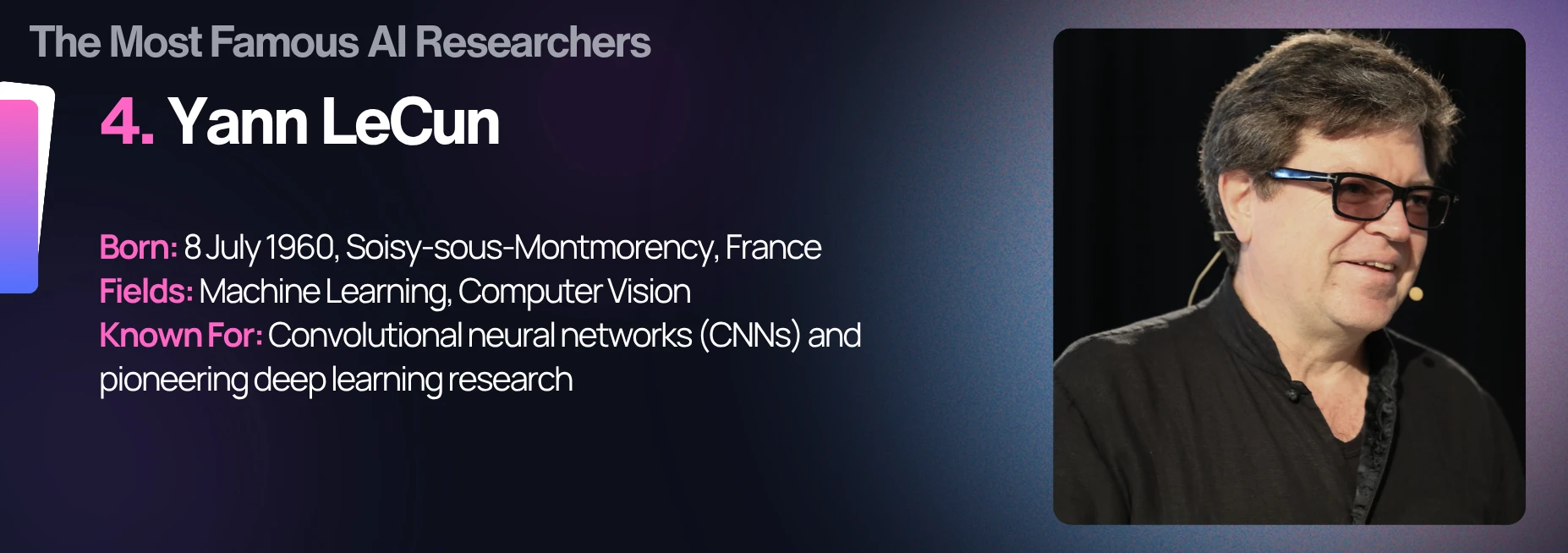
Photo: Rama, Wikimedia Commons, CC BY-SA 2.0 FR. Cropped.
Yann LeCun was doing serious work in deep learning and computer vision long before most people had ever heard those terms. That research ended up playing a major part in how modern AI handles visual information. It also helped show that neural networks could be used for real world tasks, not just lab experiments and theory.
He is especially known for his work on convolutional neural networks, which gave AI a much better way to handle images and written characters. That research played a big part in moving computer vision from clunky early experiments to something far more useful.
Education and Work Background
LeCun finished his PhD in Paris in 1987, then worked at AT&T Bell Labs before becoming a professor at New York University. He spent years leading FAIR at Meta before leaving in late 2025. He continues his work as a professor at NYU and is Executive Chairman of AMI Labs, where the main focus is on AI systems understanding the world.
5. Andrew Ng
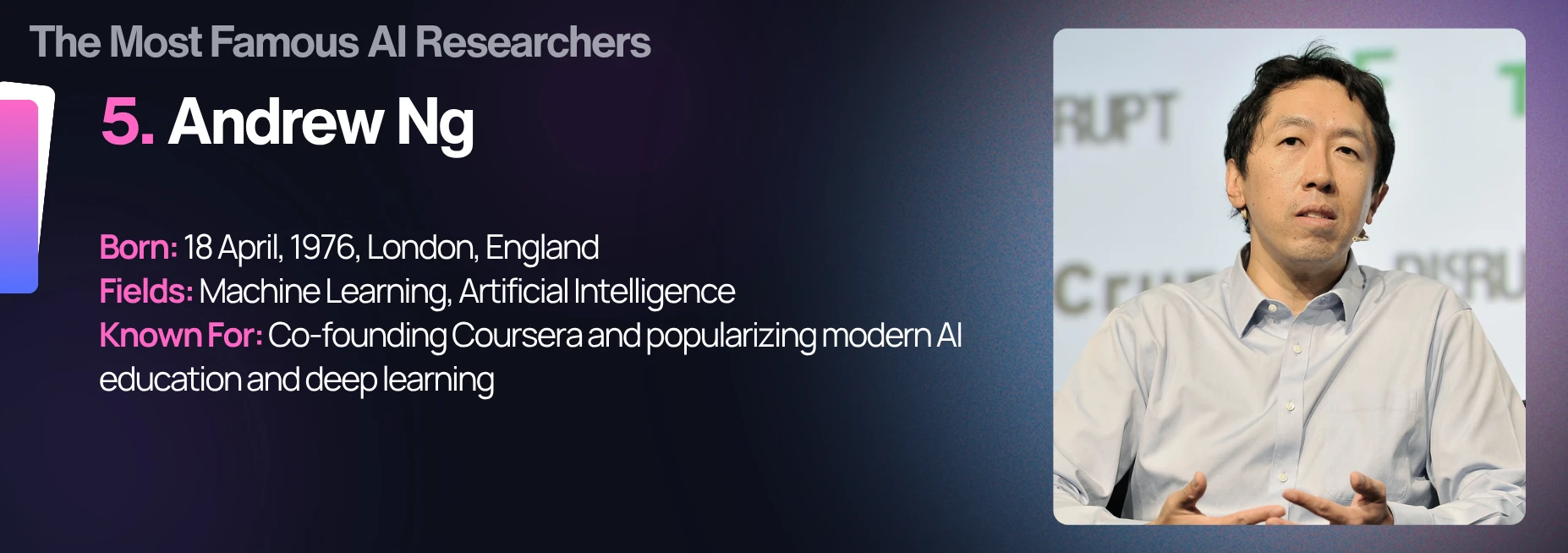
Photo: TechCrunch, Wikimedia Commons, CC BY 2.0. Cropped.
Some AI researchers build the future in silence. Andrew Ng built it, explained it, and then taught half the internet what it meant. He stands out in artificial intelligence not just because of his research, but because he helped make machine learning feel practical in the real world.
He has spent years making AI feel usable, not just impressive. Between what he has built, what he has taught, and the way he explains it, he is one of the main reasons so many people stopped seeing machine learning as a research hobby and started treating it like a real business tool.
Education and Work Background
Ng earned his PhD from UC Berkeley in 2003. He helped launch Google Brain, led major AI work at Baidu, and cofounded Coursera. Today, he runs DeepLearning.AI, leads AI Fund, and serves as Executive Chairman of LandingAI.
6. Yoshua Bengio
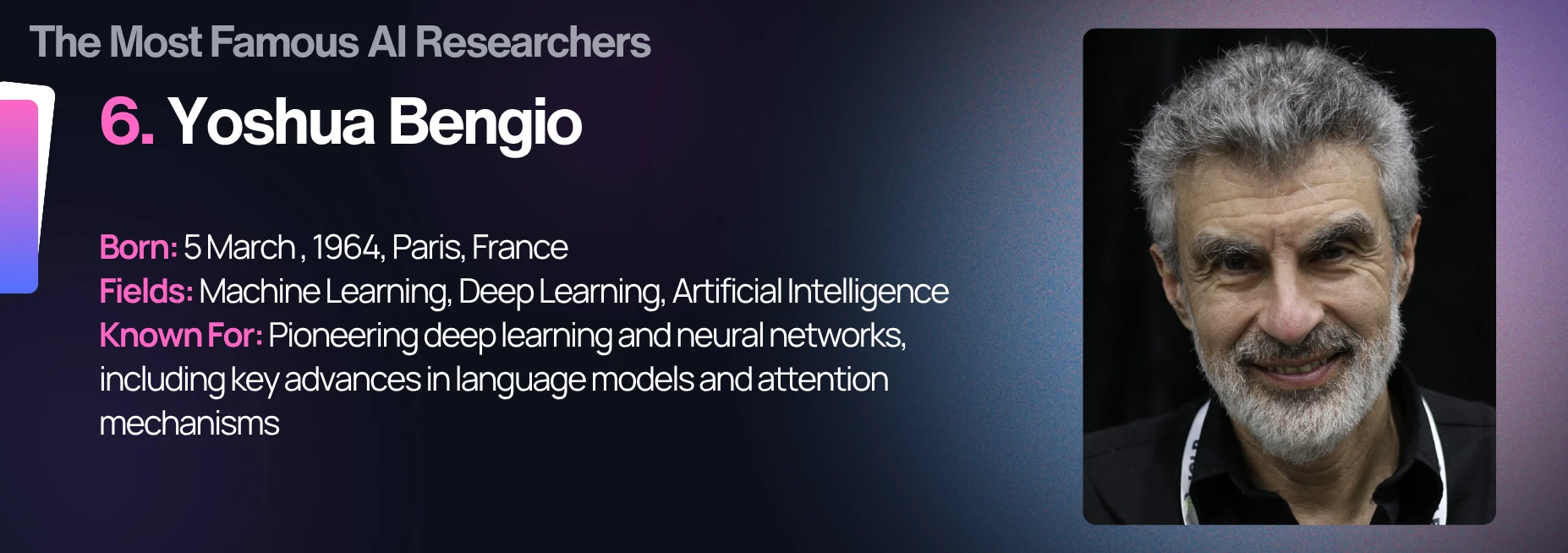
Photo: Randy (WikiPortraits), Wikimedia Commons, CC BY-SA 4.0. Cropped.
Before AI became everyone’s favorite tool for writing emails, answering questions, and powering half the internet, Yoshua Bengio was helping build the foundations behind it. His name is closely tied to the rise of deep learning and the foundations of modern AI.
He helped move neural networks and machine learning forward at a time when AI was still a much more academic field and nowhere near the giant it is today. His research played a major role in developing how modern systems learn patterns, process language, and work through huge amounts of data.
Education and Work Background
Bengio completed his PhD at McGill University in 1991. He’s been a long-time professor at Université de Montréal and founded Mila, one of the biggest AI research institutes in Canada. In 2026, he also leads AI safety work through LawZero and was elected co-chair of the UN’s Independent International Scientific Panel on AI.
7. Ilya Sutskever
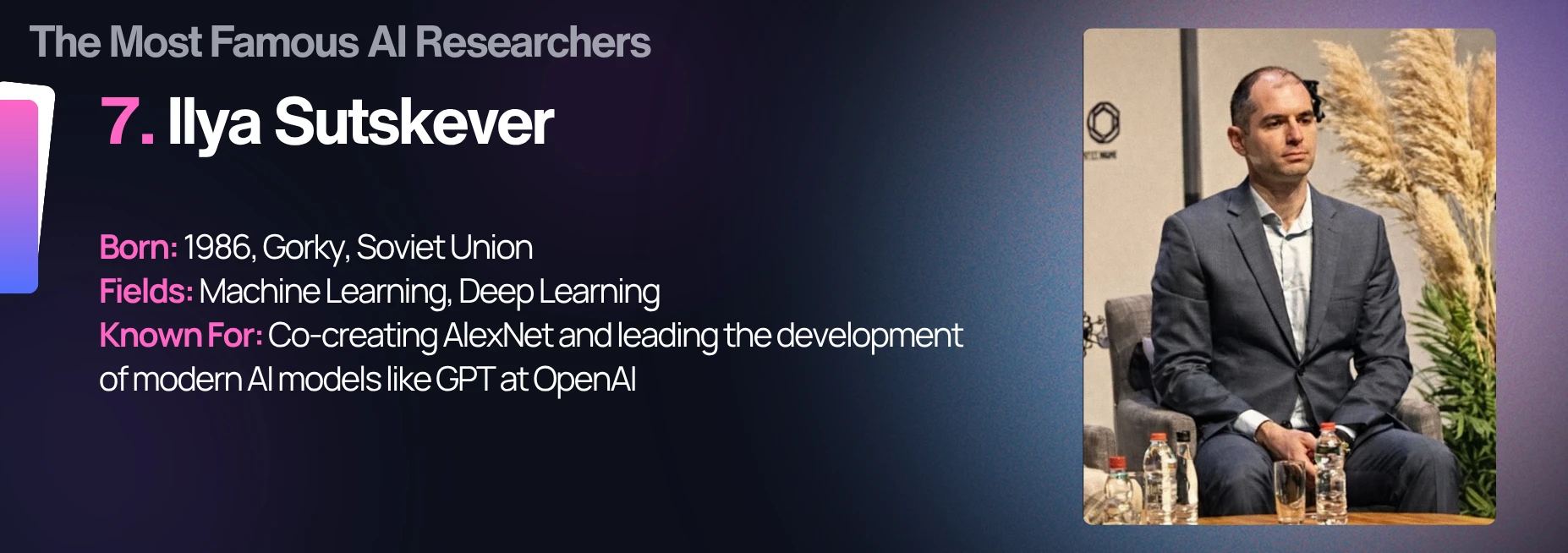
Photo: Tomer Appelbaum, Wikimedia Commons, CC BY-SA 4.0. Edited.
A lot of today’s AI boom traces back to deep learning breakthroughs, and Ilya Sutskever was right in the middle of them. He helped push the field forward and played a major role in how modern generative AI ended up where it is now.
His research has shaped how modern models learn from huge amounts of data and handle language at scale. Put simply, he was working on the foundations before most people even realized where AI was heading.
Education and Work Background
Sutskever earned a PhD in Computer Science from the University of Toronto in 2013 under Geoffrey Hinton. He worked at Google Brain, cofounded OpenAI, and is now CEO of Safe Superintelligence.
8. Andrej Karpathy
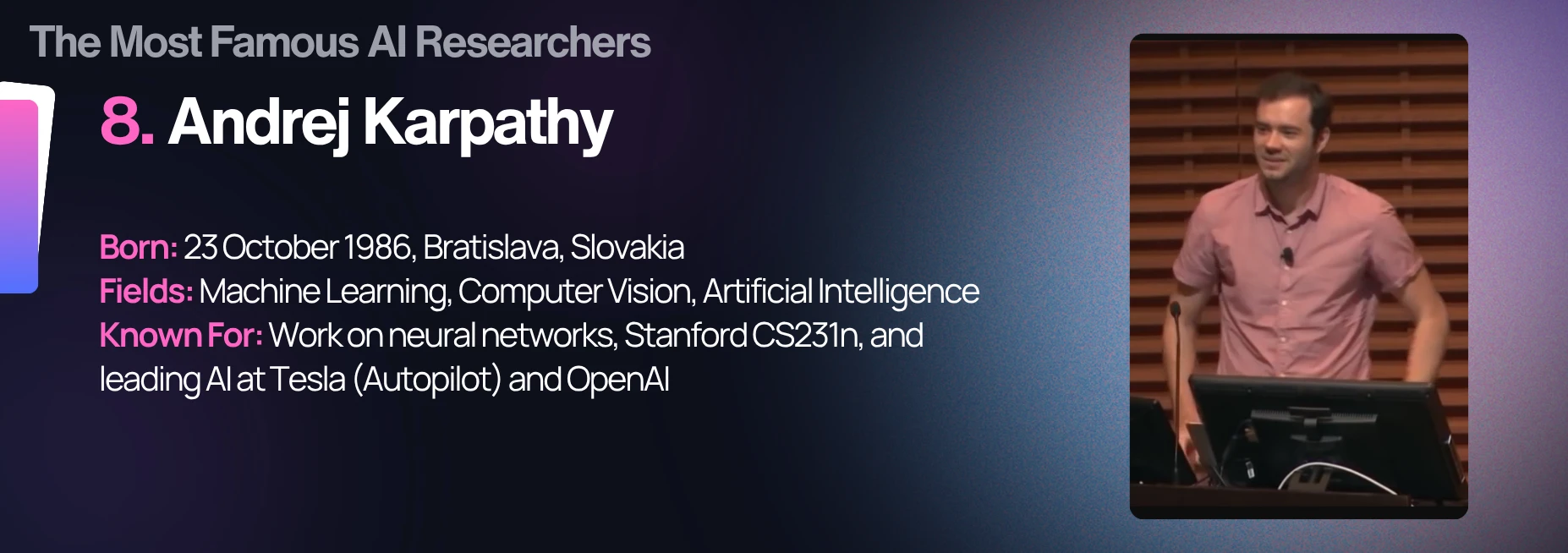
Photo: Gladwin Analytics, Wikimedia Commons, CC BY 3.0. Cropped.
If you’ve ever had AI explained in a way that actually made sense, there’s a good chance it was Andrej Karpathy. He’s become one of the clearest voices in modern AI, and he has a rare talent for taking complex ideas and making them understandable without turning it into a painful lecture.
He’s also helped shape how people learn AI today, especially in the deep learning era where everyone wants results yesterday. The reason he ranks this high is simple: he’s not just part of the modern AI story, he’s one of the people translating it for the rest of the world in real time.
Education and Work Background
Karpathy earned his PhD at Stanford in 2016. He’s been a founding member at OpenAI, led AI at Tesla, and has also spent time around Google Brain and DeepMind. Most recently, he founded Eureka Labs.
9. Ian Goodfellow
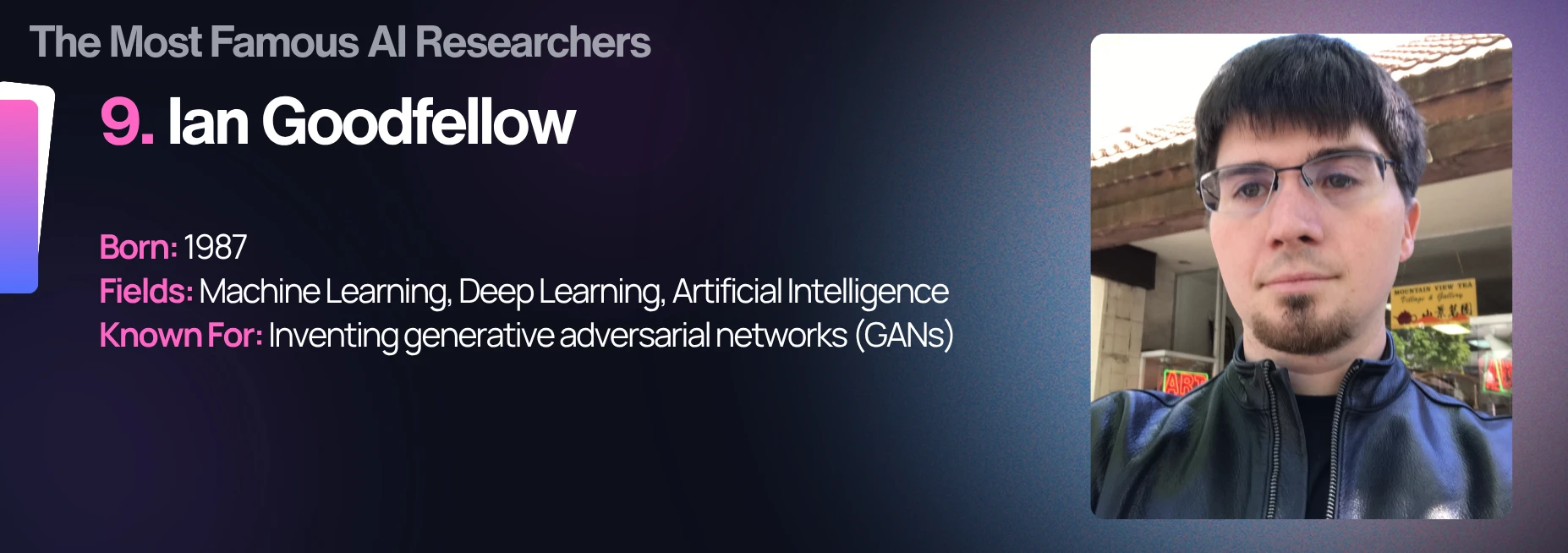
Photo: Ian Goodfellow, Wikimedia Commons, CC BY-SA 4.0. Cropped.
Ever looked at an AI image and thought, “I’m pretty sure that’s fake... isn’t it”? Ian Goodfellow helped start that problem. GANs are his big claim to fame, and the idea is simple: one model creates, the other model tries to call it out. They keep pushing each other until the fake stuff starts looking uncomfortably real.
That idea kicked off a massive wave of generative AI progress, especially in realistic image generation and the early deepfake era. He’s also one of the lead authors behind the Deep Learning textbook, which is pretty much required reading if you want to sound smart in a machine learning conversation without bluffing your way through it.
Education and Work Background
Goodfellow completed his PhD at Université de Montréal in 2014. He’s worked across the big leagues, including Google Brain, OpenAI, Apple, and now Google DeepMind. If you’re going to leave fingerprints on generative AI, that’s a pretty serious list of places to do it.
10. John Hopfield
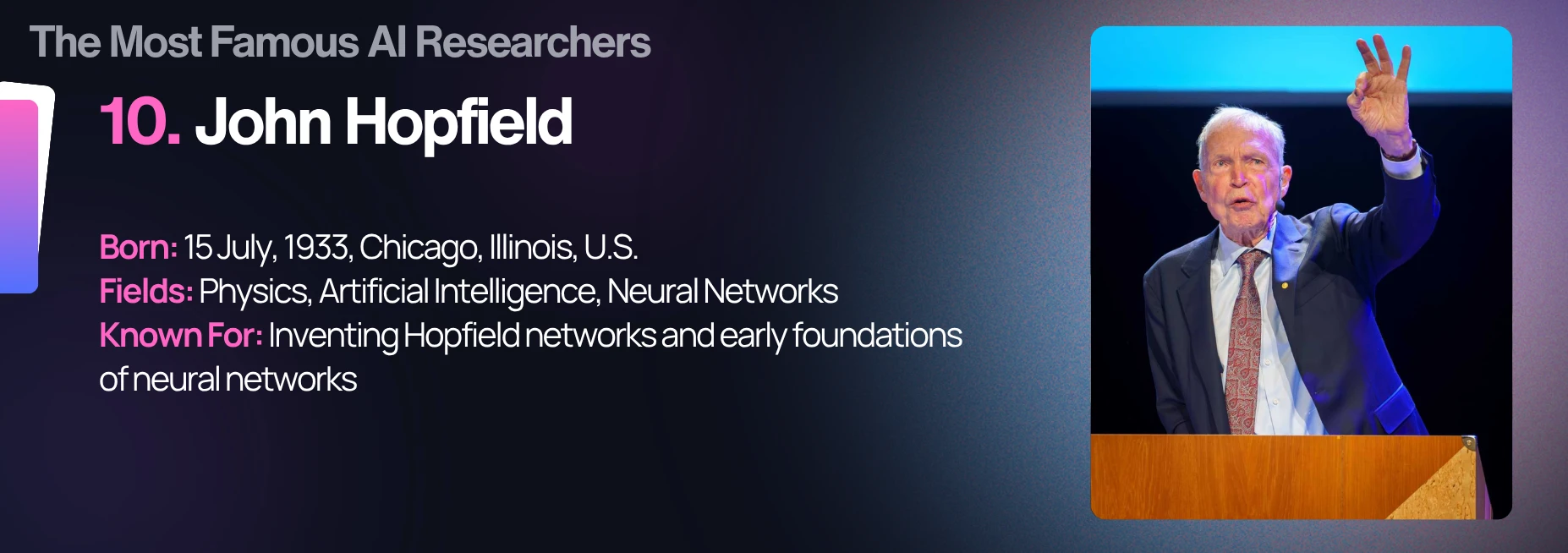
Photo: Jay Dixit, Wikimedia Commons, CC BY-SA 4.0. Cropped.
Before AI became the loud, overused buzzword it is today, he was already doing the hard work that helped give the field some real foundations. He is best known for the Hopfield network, an early type of neural network that showed how a machine could store and recall patterns, which was a major step in the early development of AI.
Hopfield was digging into memory, computation, and neural systems decades before AI became the thing everyone suddenly had an opinion on. He’s been in this game long enough to watch AI go from a “weird research idea” to “everyone’s favorite headline.”
Education and Work Background
Hopfield earned a PhD in physics from Cornell in 1958. He worked at Bell Labs, then went on to Princeton and Caltech. He now holds emeritus positions at both universities. He also shared the 2024 Nobel Prize in Physics. Now that’s a pretty decent CV if you ask me.
11. Dario Amodei
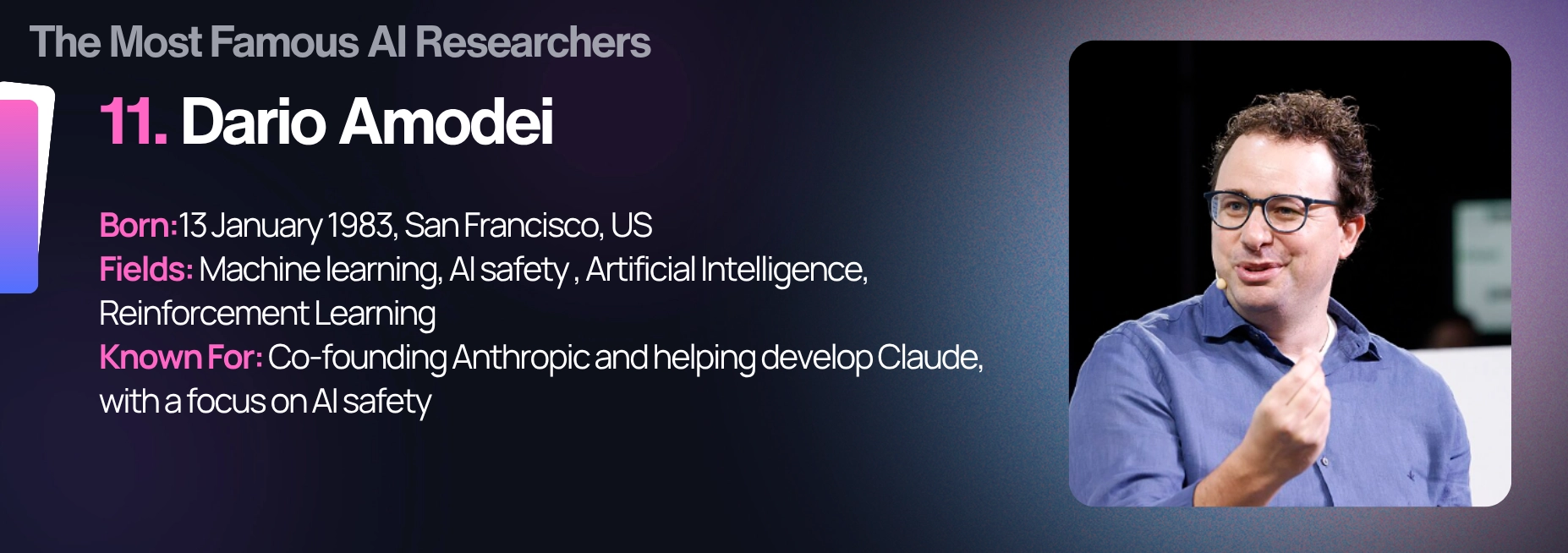
Photo: TechCrunch, Wikimedia Commons, CC BY 2.0. Cropped.
Most of the researchers on this list are known for pushing AI to the limits of what it can do. Dario Amodei is no exception.
He started off working at Baidu and Google before moving on to OpenAI. There, he contributed to the research behind GPT-2 and GPT-3.
Dario later left OpenAI to cofound Anthropic. As CEO, his company created Claude, one of ChatGPT’s biggest rivals.
He has also been very open about what could go wrong with AI. In his essay, “The Adolescence of Technology,” he explains the potential risks AI poses.
Safety has been a major focus for Claude’s development from the very start. During simulated testing, Anthropic discovered that models engaged in troubling behaviors, such as blackmail and deception. So while Dario is helping build more powerful AI… his hand remains close to the emergency “STOP” button.
Education and Work Background
While attending Lowell High School, Dario Amodei was selected for the US Physics Team. After graduating, he studied physics at Caltech and later transferred to Stanford University, where he earned his bachelor's degree. He then completed a PhD in physics at Princeton University. There, he researched the behavior of neural circuits. Afterward, he continued his research during a postdoctoral position at Stanford University School of Medicine.
12. Richard Sutton
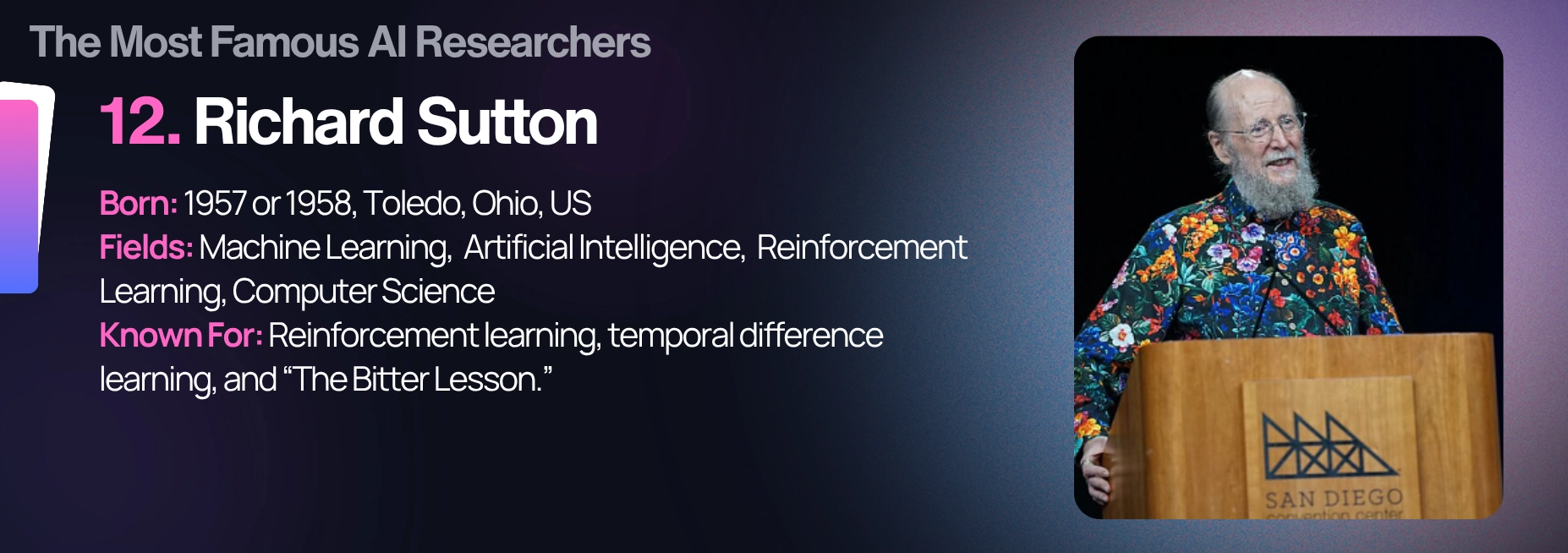
Photo: Xuthoria, Wikimedia Commons, CC BY-SA 4.0. Cropped.
They say one of the best ways to learn is through trial and error. Well, apparently that works for machines too. And Richard helped make that happen.
Richard started off studying behavioral psychology in his early years. This laid the groundwork for understanding how people learn. He later helped develop ways for AI to learn from experience, feedback, and mistakes.
It’s similar to training a puppy on what it's allowed to chew. The couch looks like an excellent option at first, but through praise, guidance, and reward, it gradually learns that the toy is a better choice. This technique, reinforcement learning, shows a similar principle in AI. Rather than coaching the AI step by step all the way to the end, it tries different actions and uses feedback to figure out which one leads to a better result. His groundbreaking work is why he is often referred to as the “Father of Reinforcement Learning.”
Education and Work Background
After getting his degree in psychology from Stanford University in 1978, he completed his PhD in computer science at the University of Massachusetts Amherst in 1984. He shared the 2024 ACM A.M. Turing Award. This award is often referred to as the “Nobel Prize” of computing. Today, he is a professor of computing science at the University of Alberta and chief scientific advisor at the Alberta Machine Intelligence Institute.
Wrapping Up
So there you have it!
The names that helped build modern AI into what it is today. While the world keeps obsessing over what AI can do next, it is worth remembering who helped get it here in the first place. These researchers did not just follow the rise of artificial intelligence. They helped shape it, challenge it, and push it forward. Some changed how machines see. Some changed how machines learn and communicate. Some helped turn AI into a tool that could tackle problems far beyond the lab. Not bad for a field that once sounded like science fiction.
To me, this list is a reminder that behind every big AI breakthrough, someone had to do the hard part first.
The Top 13 AI Documentaries In 2026
Uncover the dark side of artificial intelligence, minus the Hollywood lasers.
Check out our top picks
An Operations Analyst on a mission to make the internet safer by helping people stay a step ahead of cyber threats.